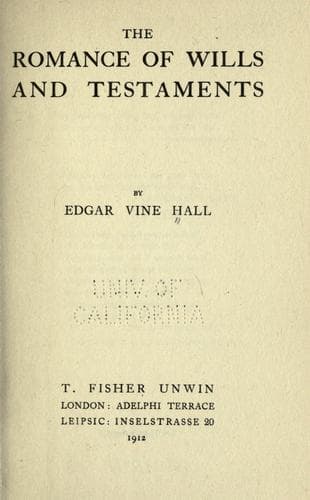
The Romance of Wills and TestamentsVine Hall, Edgar
History
The Romance of Wills and Testaments
Vine Hall, Edgar
Wills -- Great Britain -- Miscellanea
In the following we are able to pry a little further into the life of
a mariner, as far back as the sixteenth century. Its vigour smacks of
those adventurous days, if not wholly edifying for one about to take
leave of land and sea for ever. “Memorandum that Thomas Smith, late
whiles he lived of London, gent., being captain at sea of a frigate or
ship called the _Morning Star_, belonging to the Earl of Cumberland,
being the 26th, 27th, and 28th of August A.D. 1594 or thereabouts
chased upon the high seas by a fleet of Spaniards of twenty two sail or
thereabout ... and in great danger of taking, and having escaped that
peril, within a day or two was demanded and asked by some that were
in the frigate what he would have done with his goods and substance,
and how he would have the same bestowed if he should happen to die or
be taken or slain in that dangerous voyage. Whereupon the said Thomas
Smith answered and said that, ‘in case I shall die be taken or slain
in this voyage, I give all that I have to my brother Edward Smith,
for that he hath followed me in these actions and applied himself to
my business, and hath been at the getting of part thereof.’ And being
asked whether he had any other brother, and what he would give him, he
replied that ‘as for my other brother, let him content himself with
that he hath had already, for he shall have no more,’ saying further
that ‘he hath had a great deal of money of me already.’ And being put
in mind of his wife and asked whether he would give her nothing, he
answered cursing her and said that she had played the lewd woman, and
that she hath had enough already, and should suffice herself with that
she had, for more she should not have; adding further, ‘my brother
Edward, if I die, shall have all that I have,’ or the like in effect:
which words the said Thomas did speak and utter in the presence of John
Thomas, William Trigger, James Bell, George Lone, Thomas Foster, and
others.”
CHAPTER VI
THE POLYCODICILLIC WILL
“She bequeaths, she repeats, she recalls a donation,
And ends by revoking her own revocation;
Still scribbling or scratching some new codicil,
Oh! success to the woman who makes her own will.”
“ANCIENT, CURIOUS, AND FAMOUS WILLS.”
In preceding papers examples have been given of wills delayed till the
eleventh hour: but to some the making of wills and codicils becomes,
at times, a hobby, if not an obsession. “What is a poor woman with no
family to do? Affection for nieces must fluctuate.” “You can always
make a codicil,” answered the lawyer, in the “Light Side of the Law.”
Changes and counter-changes in wills have not been neglected by writers
as a source of literary material. Revocations made in anger or in sheer
vacillation of mind are excellent bases for tales of adventure or love.
Public-domain text, read in full here on John Shaqi.
Reviews
Reviews
No reviews yet
Be the first to share your thoughts on this work.
Elsewhere in the archive
Join the Discussion
Join the discussion
Sign in to leave a comment or review.
Sign InorCreate an account