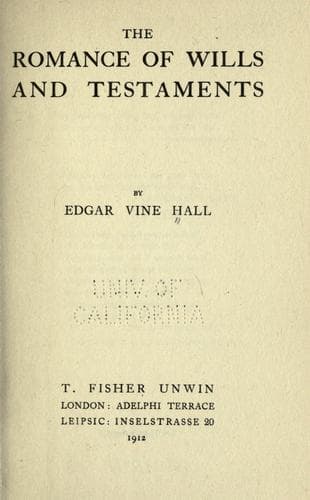
The Romance of Wills and TestamentsVine Hall, Edgar
History
The Romance of Wills and Testaments
Vine Hall, Edgar
Wills -- Great Britain -- Miscellanea
The title of this essay has been taken from a passage in R. C.
Trevelyan’s operatic fable “Sisyphus.” The king Sisyphus is dying, but
there is still a fear that he may revive sufficiently to tamper with
his testamentary writings. Even now his last will may be annulled.
_Chorus._ “Hush! Beware! Beware!
But now his thin lips stirred.
Have a care!
He liveth still.
Speak no rash word,
Lest ye be overheard,
And your expectations crossed,
When he alters a tenth time to your cost,
With a last bitter codicil,
His nine-times-altered will.
_Sisyphus._ ‘My wife, my sons, draw near my bed, for I
Once more would speak with you before I die,
Where is my lawyer? Let him fetch my will.
I wish to add another codicil.’
_Chorus._ Another codicil!
Another still
To his polycodicillic will!
Ah! what may this portend?
’Tis the tenth he hath penned.
Soon may death seal an end.”
To discover the real wishes and intentions of a testator is often a
difficult matter, when, in addition to an already voluminous will,
codicil after codicil is added, clause after clause revoked. At a first
reading wrong impressions may easily be taken and bitter disappointment
caused. Only those who have handled such documents can realise the
confusion which may arise by the indiscreet addition of codicils. It
often happens, too, that while the will is legally and carefully drawn
and attested, the codicils are carelessly and inadequately framed.
Among the Romans there was an informal will called _codicillus_, but
the English codicil requires as strict formality as the will. It is
wiser to start afresh.
Anne Judith Bristow, in 1784, at the age of 76, saw the necessity of
adjusting her will to events. It is translated from the French. “This
is the sixth will which I have made since the year 1776, some changes
having happened which made me strike out and obliterate, without,
however, writing it wholly again: this I hope will be the last, for I
have completed the age of 76 years. I every day expect death. I dread
dotage still more. Therefore, without losing time, here is that which I
wish to be carried into execution at my decease.” She lived four more
years, and the changes and chances of her mortal life were such that
she had, after all, to make two codicils, in the first of which, dated
19th of July, 1788, we learn that a daughter mentioned in the will was
now dead. The second codicil was dated September 7, 1788. Soon after
that she must have died, for on January 26, 1789, the will and codicils
were proved.
Public-domain text, read in full here on John Shaqi.
Reviews
Reviews
No reviews yet
Be the first to share your thoughts on this work.
Elsewhere in the archive
Join the Discussion
Join the discussion
Sign in to leave a comment or review.
Sign InorCreate an account