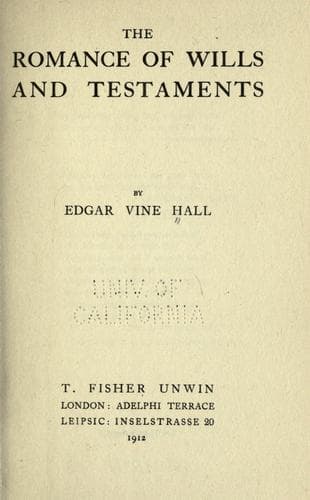
The Romance of Wills and TestamentsVine Hall, Edgar
History
The Romance of Wills and Testaments
Vine Hall, Edgar
Wills -- Great Britain -- Miscellanea
The Dean seems to have lived in constant apprehension of death: in
April, 1724, he was “labouring under great bodily infirmities which
daily call upon me to remember my latter end”; but he lived till 1759,
being in that year “of sound mind and not forgetful of my mortality.”
Twice in his testamentary papers he commends his soul to God in prayer.
“And so I once more commend myself to Thee, O Father of Spirits,
professing myself to die, however wickedly and unprofitably I have
lived, in the Christian religion as taught in the Church of England,
lamenting her divisions and disputes about obscure and unnecessary
things, being in peace and charity with all the world.” (1735.) “And
first I recommend into Thy hands, Almighty and Everlasting God, my
immortal soul, beseeching Thee in all changes to keep it close unto
Thyself, and that I may in the day of Judgment find such mercy as I
shall stand in need of through the merits of a blessed Redeemer.” Wills
sometimes begin or break out thus in prayer. “Good God direct me in
this and all other good things which I shall go about,” cries Phillippa
Jones in 1768, and Samuel Gillam in 1787: “O Lord, Thou art great and
good, but I am a vile sinner; give me all the mercies I stand in need
of for time and for eternity, for the sake of Jesus Christ; and through
Him accept all my thankgivings for whatever I have and hope for: To the
Father Son and Holy Spirit be eternal glory, Amen.” The Rev. Richard
Forster (1728) most humbly commends his soul “into the hand of God the
faithful Creator, most earnestly beseeching Him that through the merits
and mediation of the merciful Redeemer who purchased it by His blood,
being purged and cleansed from all the defilement contracted in this
miserable and naughty world, the lusts of the flesh, or the wiles of
Satan, and being sanctified by the Holy Ghost, it may be precious in
the sight of the glorious Trinity, and be presented without spot in the
presence of the Divine Majesty.”
Public-domain text, read in full here on John Shaqi.
Reviews
Reviews
No reviews yet
Be the first to share your thoughts on this work.
Elsewhere in the archive
Join the Discussion
Join the discussion
Sign in to leave a comment or review.
Sign InorCreate an account