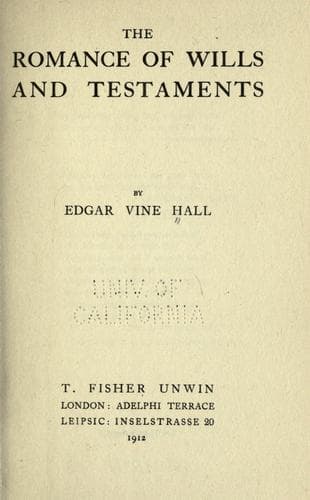
The Romance of Wills and TestamentsVine Hall, Edgar
History
The Romance of Wills and Testaments
Vine Hall, Edgar
Wills -- Great Britain -- Miscellanea
Of peculiar interest, again, are some of the wills of French
Protestants in this century. Two may be quoted as differing types,
which yet help to illustrate one another as well as the times
they represent. The first is that of John Lacombe, translated
(indifferently) from the French and proved on May 4, 1702. “In the
name of the Father of the Son and of the Holy Ghost, Amen. I John
Lacombe underwritten, born in the city of St. Hipolite, ... having
settled my house and lived the greatest part of my time in the city
of Paris, after having received so many graces and favours from the
mercy of God in all the course of my life, and chiefly in this time of
affliction and grief for His Church in which so many persons do sigh
after the liberty of serving Him purely according to the motives of
their conscience, I render Him my most humble actions of grace, and
desire that one may know after me that I do bless Him eternally from
the profoundest of my heart, for the kindness which He hath done me for
conducting me through His providence in this city wherein I find the
pureness of His service, and the means to render Him my adorations, in
mind and truth according to His word. I am come into it with the five
children which it hath pleased God to leave me of a greater number
which He had given me. I have still in France Elizabeth Beauchamp my
wife, their mother. I hope that God shall grant me grace to see her in
this country to end together the few days which remain to us: to live
and to die in it in peace and tranquillity, that is the prayer which I
make daily to God. And as I am advanced in years, being in my seventy
fifth year, very infirm of body, but of sound mind and understanding by
the grace of God, and that the hour of my death is as much uncertain
as it is sure, I am upon the watch expecting the time of my going off.
I beg instantly to my God the forgiveness of my sins, and to grant
me mercy for the sake and through the merits and intercession of our
Lord Jesus Christ, my only Redeemer. I invoke all the adorable Trinity,
one only God, eternally blessed. And desiring to live and die in the
profession of the reformed religion, I pray God when my time shall be
come to receive me in His rest.”
The will of Isaac Rigoullott (1720), translated out of Dutch, is more
truculent. “In the Name of God, Amen. Because death is certain and
the hour thereof uncertain, after having recommended my body and soul
to God by Jesus Christ our Lord through His Holy Spirit, and being
come out of France by reason of the persecution against our holy
Christian religion, forcing us to worship the Bread and Wine as being
the flesh and bone of our Lord Jesus Christ, making us to believe in
the invocation of Saints, the imaginary fire of Purgatory, and other
falsehoods inspired by the spirit of the Devil, to worship the true God
in spirit and in truth as He hath commanded us in His holy word in the
Old and New Testament, I Isaac Rigoullott ... give,” &c.
Public-domain text, read in full here on John Shaqi.
Reviews
Reviews
No reviews yet
Be the first to share your thoughts on this work.
Elsewhere in the archive
Join the Discussion
Join the discussion
Sign in to leave a comment or review.
Sign InorCreate an account