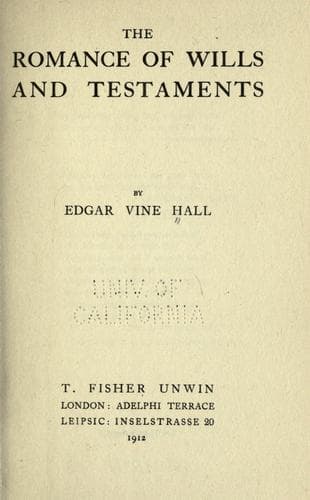
The Romance of Wills and TestamentsVine Hall, Edgar
History
The Romance of Wills and Testaments
Vine Hall, Edgar
Wills -- Great Britain -- Miscellanea
Other conditions and stipulations might be quoted at length, as that
racehorses should not be kept, moustaches should not be worn, a certain
profession should be followed, a certain house occupied for part of
the year, a certain person precluded from living in the house, or
“that in the event of the death of her husband, she shall not come
to reside within twenty miles of Charing Cross.” Daniel Seton (1803)
leaves his son Andrew as residuary heir “on condition he goes to Europe
on his mother’s death and marries and settles: in failure of him I
give the option to Daniel.” Francis Gybbon (1727) of Bennenden, Kent,
late merchant of Barbados, gives to his “kinsmen Leonard Gybbon and
his brother—Gybbon, the wheelwright, both of Gravesend in Kent, sons
of Arthur Gybbon, all that tract of land called Mount Gybbon upon
the branches of Unknown Creek near Cohansey, in the province of West
Jersey in America, to them and their heirs for ever, provided they go
and settle upon it: if they do not in three years, then to revert to
Francis Gybbon my executor, ... the quantity being 5,600 acres.”
But frequently the testator only states his inmost beliefs and desires,
leaves a prayer or sermon as his solemn admonition when he shall have
passed away. A military man, recently deceased, expressed such beliefs
and desires in his will: “I desire to bring home to the minds of my
sons and of each and every young man who may hereafter take benefit
in my property under this my will, how strongly I hold to the view
that every man should during some substantial portion of his life,
and certainly during his early manhood, have some definite occupation
and lead a useful life, and should not suffer wealth or any accession
of wealth or other temptation to tempt him into idleness and a mere
loafing and useless existence. I might have so framed this my will as
to have made idleness operate to forfeit the interests hereby conferred
on my sons, or other young men, in my property, but I foresee that such
a provision might, in some cases, work hardships, and I prefer to hope
and to trust, as I do, that no son of mine, and no other young man who
may, under this my will, succeed to the enjoyment of any property of
mine, will so disregard my views herein expressed as to lead the life I
so strongly deprecate.”
Public-domain text, read in full here on John Shaqi.
Reviews
Reviews
No reviews yet
Be the first to share your thoughts on this work.
Elsewhere in the archive
Join the Discussion
Join the discussion
Sign in to leave a comment or review.
Sign InorCreate an account