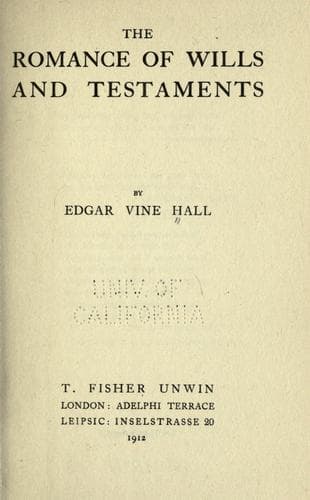
The Romance of Wills and TestamentsVine Hall, Edgar
History
The Romance of Wills and Testaments
Vine Hall, Edgar
Wills -- Great Britain -- Miscellanea
It is not surprising that wills should occur in which distrust or
horror of alcohol is prominent. “My experience,” says one, “acquired
as a large employer of labour and as a Justice of the Peace, and my
observation of what is hourly taking place, have convinced me that
the present facilities for the sale of intoxicating liquors operate
to the prejudice, both morally and materially, of large masses of
the community, and that these facilities ought to be curtailed.” He
therefore directs that his real estate shall be sold only on condition
that the purchaser allows no building to be erected thereon for any
purpose connected with intoxicating liquors. The condition was to last
“for twenty-one years after the decease of the longest lived survivor
of her late Majesty Queen Victoria,” and the term would have been
extended had the law allowed.
A brewer, on the other hand, provided that, should the licence of
any one of forty-four public-houses and twelve off-licence shops
belonging to his company be forfeited between the date of his will and
his death, an equivalent amount should pass to a University instead
of to the town for whose benefit he left his residuary estate. His
reason, he stated, was that if the licence was lost through the conduct
of the frequenters of the house, their action would cost the town a
considerable sum, while if it were lost through the action of teetotal
magistrates the town would be punished. A total abstainer, he declared,
had no more right to compel a temperate man to abstain from drinking
his particular beverage than the temperate man had a right to compel
the total abstainer by force of law to drink it. But he hoped the first
contingency would make the inhabitants careful of their conduct.
Curious glimpses of life in olden days are given in conditions which
now and then are enjoined. Edmund Clifton (1547) gave to Sir Geruys
Clifton, knight, “the standing cup of silver and gilt and a goblet
parcel gilt, which he hath already in his custody, upon condition that
he help and assist my wife, and do not enforce her nor be about her
to take any husband but such as she shall willingly be pleased and
contented with, nor be about to do her any other displeasure, neither
by word nor deed; and if he do anything contrary to this condition,
then this bequest to be void.” He also gave 40s. to Jane Mering “of
this condition, that she shall profess and knowledge herself not to
have done her duty to me and my wife, before Mr. Parson and four or
five of the honester men in the parish.” He seems to have had the
spark of eccentricity in him, and perhaps Jane Mering was not wholly
in the wrong. Would that we had the sequel of the story!
Public-domain text, read in full here on John Shaqi.
Reviews
Reviews
No reviews yet
Be the first to share your thoughts on this work.
Elsewhere in the archive
Join the Discussion
Join the discussion
Sign in to leave a comment or review.
Sign InorCreate an account