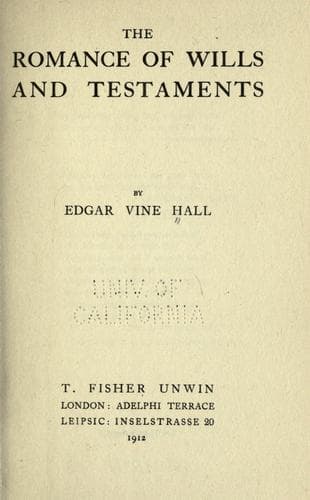
The Romance of Wills and TestamentsVine Hall, Edgar
History
The Romance of Wills and Testaments
Vine Hall, Edgar
Wills -- Great Britain -- Miscellanea
But will-making may have a sinister attraction, a suspicion of
something hardly sane. Fragments of Chatterton’s will have already
been quoted. Apprenticed to an attorney, he strove to get free, and
as a last means to induce his master to dismiss him, he left in the
office this strange document, dated April 14, 1770, in which his
approaching suicide was announced. It had the effect desired. “All
this wrote between 11 and 2 o’clock Saturday, in the utmost distress
of mind. April 14, 1770. This is the last will and testament of me,
Thomas Chatterton, of the city of Bristol; being sound in body, or
it is the fault of my last surgeon, the soundness of my mind, the
coroner and jury are to be judges of, desiring them to take notice
that the most perfect masters of human nature in Bristol distinguish
me by the title of the Mad Genius; therefore, if I do a mad action,
it is conformable to every action of my life, which all savoured of
insanity.” There follow directions for tomb and tablets, and bequests
of satirical or bitter humour. “I leave also my religion to Dr.
Cutts Barton, Dean of Bristol, hereby empowering the Sub Sacrist to
strike him on the head when he goes to sleep in church.... I leave my
moderation to the politicians on both sides of the question.... I give
my abstinence to the company of the Sheriff’s annual feast in general,
more particularly to the Aldermen.... I leave the young ladies all the
letters they have had from me, assuring them that they need be under
no apprehension from the appearance of my ghost, for I die for none of
them.... I leave my mother and sister to the protection of my friends,
if I have any. Executed in the presence of Omniscience this 14th day of
April, 1770.”
But probably of imaginative and fantastic wills the most remarkable
is one said to be the work of a lunatic in America, more surprising
for its beauty than are others for their satiric or malicious
inventiveness.[2]
“ ... I leave the children for the term of their childhood the flowers,
fields, blossoms, and woods, with the right to play among them freely,
warning them at the same time against thistles and thorns. I devise to
the children the banks, the brooks, and the golden sands beneath waters
thereof, and the white clouds that float high over the giant trees, and
I leave to the children long long days to be merry in, and the night
and the moon and the train of the Milky Way to wonder at.
“I devise to the boys jointly all the useful fields, all the pleasant
waters where one may swim, all the streams where one may fish or
where, when grim winter comes, one may skate, to have and hold the
same for the period of their boyhood.... I give to the said boys each
his own place by the fireside at night, with all the pictures that may
be seen in the burning wood, to enjoy without let or hindrance and
without any encumbrance or care.
Public-domain text, read in full here on John Shaqi.
Reviews
Reviews
No reviews yet
Be the first to share your thoughts on this work.
Elsewhere in the archive
Join the Discussion
Join the discussion
Sign in to leave a comment or review.
Sign InorCreate an account