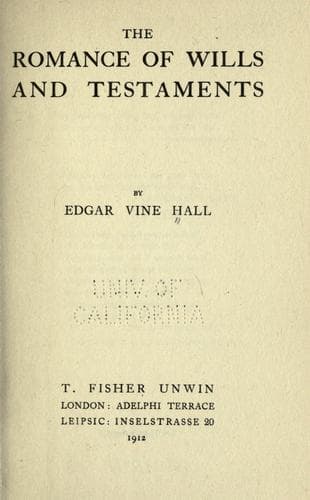
The Romance of Wills and TestamentsVine Hall, Edgar
History
The Romance of Wills and Testaments
Vine Hall, Edgar
Wills -- Great Britain -- Miscellanea
“To lovers I devise their imaginary world with whatever they may need,
as stars, sky, red roses by the wall, the bloom of the hawthorn, the
sweet strains of music, and aught else they may desire.... To the loved
ones with snowy crowns I bequeath happiness, old age, the love and
gratitude of their children, until they fall asleep.”
FOOTNOTES:
[2] A few passages are here quoted from this will as it appeared in
the _Daily Telegraph_. It seems that its appellation “The Lunatic’s
Will” is erroneous and that it was a deliberate literary composition.
See Harris’s “Ancient, Curious, and Famous Wills” referred to in the
Preface. In that book it is quoted in full and its real origin given.
CHAPTER X
STRIFE
Thomas Penistone, in the preamble to his will quoted in “The Way of
All Flesh,” insists on the confusion or disputation an intestacy
might cause. The regular formula, occurring over and over, is that
the will is made for avoiding controversies after death; or, as one
John Nabbs says (1665), “the unhappy controversies usual in default
of such settlements.” Robert Collyer, whose will was proved November
8, 1665, makes a peculiarly interesting addendum as to the law in his
day: “the reason why I trouble not myself with witnesses is because a
will so made by a man himself, although many imperfections in regard
of form and the like may be in it, yet it is as good in law as if it
were published and declared before many witnesses; which if people did
but take notice of, many wills would be made that are not and much
contention prevented; which I heard Serjeant Maynard plead for law in a
case between Master Christopher Coles and Master Walter Bartellott at
Westminster Hall.”
There is a pathetic fallacy in this expectation. Some controversies may
be avoided, but bitter disputes too often are aroused—disputes about
the will’s validity, the meaning of its provisions, the capacity of the
testator, the legality or interpretation of a bequest, its justice or
injustice, and so on interminably. Such a work as Theobald’s “Law of
Wills” illustrates, by the thousands of decisions it brings together,
what questions and queries arise on the legal and interpretative sides
alone.
Public-domain text, read in full here on John Shaqi.
Reviews
Reviews
No reviews yet
Be the first to share your thoughts on this work.
Elsewhere in the archive
Join the Discussion
Join the discussion
Sign in to leave a comment or review.
Sign InorCreate an account