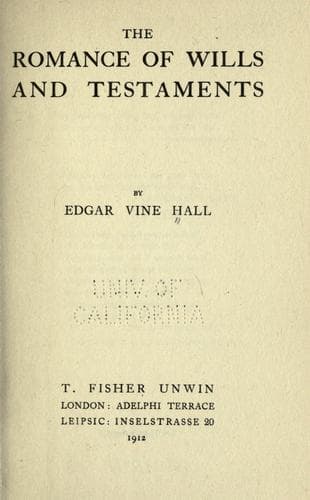
The Romance of Wills and TestamentsVine Hall, Edgar
History
The Romance of Wills and Testaments
Vine Hall, Edgar
Wills -- Great Britain -- Miscellanea
As a final instance of family affection the following expression of
gratitude, interesting in that the person eulogised was afterwards
Archbishop of York, must not be overlooked. The testator, Major William
Markham, died in 1771, and on the 21st of January, 1780, administration
with the will was granted to his son, then William, Lord Archbishop
of York. He says: “My reason for thus forming my will is founded upon
a principle of gratitude to my eldest son, whose interest restored me
when reduced to my majority in Major General Lascelles’ regiment. To
the same interest I owe the liberty I had from His Majesty of selling
my majority at the best advantage, without which liberty I could have
never sold and consequently never have been master of said money,
which I now gratefully return to him who in a manner gave it. The said
William Markham’s interest brought me out of captivity to London,
from which time I am obliged to acknowledge I have entirely lived on
him. I should be very remiss in not mentioning one remarkable instance
of his generosity, which was when the Duke of Buccleugh asked Dr.
Markham, then only a student in Christchurch, how he could serve him
he instantly answered ‘by recommending my father Major Markham to His
Majesty for a Lieutenant Colonelcy.’ But the greatest obligation I lie
under to Dr. Markham is for his having made an ample provision for my
two younger sons George and Enoch, whom I most heartily recommend to
his further care and patronage, which I am fully persuaded is quite
unnecessary to mention.”
The Archbishop who earned such gratitude from his father was buried
in Westminster Abbey on November 11, 1807, aged eighty-nine, and a
monument was raised to his memory by his grandchildren. He was a man
of character, “a pompous and warm-tempered prelate, with a magnificent
presence and almost martial bearing.” He is described by Walpole as
“a pert, arrogant man,” and as “that warlike metropolitan Archbishop
Turpin.” Bentham gives an earlier and equally curious portrait of him
as head master of Westminster School. Bentham was at Westminster 1755
to 1760. “Our great glory was Dr. Markham; he was a tall, portly man,
and ‘high he held his head.’ He married a Dutch woman who brought him a
considerable fortune. He had a large quantity of classical knowledge.
His business was rather in courting the great than in attending to the
school. Any excuse served his purpose for deserting his post. He had a
great deal of pomp, especially when he lifted his hand, waved it, and
repeated Latin verses. If the boys performed their tasks well, it was
well; if ill, it was not the less well. We stood prodigiously in awe of
him; indeed, he was an object of adoration.”
Public-domain text, read in full here on John Shaqi.
Reviews
Reviews
No reviews yet
Be the first to share your thoughts on this work.
Elsewhere in the archive
Join the Discussion
Join the discussion
Sign in to leave a comment or review.
Sign InorCreate an account