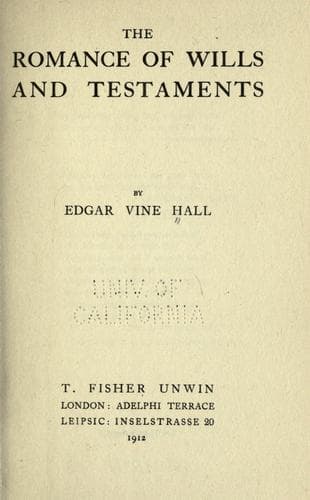
The Romance of Wills and TestamentsVine Hall, Edgar
History
The Romance of Wills and Testaments
Vine Hall, Edgar
Wills -- Great Britain -- Miscellanea
Gifts with expressions of love and gratitude are common outside the
family. Recently legacies were left to children of a confectioner “in
appreciation of their attention to my luncheon wants for twenty years.”
A large estate was bequeathed to the widow of a medical attendant “in
consideration of her husband’s constant kindness and attention to me
both personally and professionally.” Certain silver articles were left
to one “who has been for many years a most kind and sympathetic friend,
passing many dull weary hours with me listening to my griefs and
worries.” Of interest is a recent bequest in a builder’s will, who left
a sum sufficient to put into proper repair and to provide in perpetuity
for the maintenance and gardening and carpet bedding of the grave
of his first partner, “for whom,” he says, “I entertain the highest
respect and regard.”
Florence Nightingale left several bequests, expressing affection and
gratitude therewith. Two friends she was determined not to leave
unmentioned, although they had predeceased her. “To my beloved and
revered friends, Mr. Charles H. Bracebridge, and his wife, my more
than mother, without whom Scutari and my life could not have been,
and to whom nothing that I can say or do would in the least express
my thankfulness, I should have left some token of my remembrance, had
they, as I expected, survived me.”
These are recent instances, but we may cull them from old records too.
Thomas Avery, of Dolton in Devon, made a nuncupative will on May 21,
1634. He gave “unto Edward Levaton and Elizabeth Warre, in respect of
their pains they had taken with him, the said deceased, and out of his
love and affection unto them in regard he had brought them up in his
own house and that they had been long with him and had taken pains
about his work and had travelled about his business and occasion, the
sum of £100 apiece”; the residue to his brother John “in regard of his
brotherly love and affection unto him, and in respect and recompense
of his said brother’s travail and pains which he had undergone and
taken for him, the said deceased, when none other of his kindred would
do anything for him.” Philip Doddridge in a codicil says: “And as the
providence of God hath been pleased to give me a particular interest
in the friendship of the truly honourable George Littleton, Esquire,
I beg he would please to accept five guineas to buy him a ring, which
I desire him to wear at least ten days in every year from the 19th
of January, (that ever memorable day,) in memory of the unfeigned
affection that has subsisted between us.” In his will he gives £5 to
Elizabeth Bagnal “as a token of the affectionate care she took of my
eldest child during her last illness, a tender circumstance which it is
not possible for me ever to forget.”
Public-domain text, read in full here on John Shaqi.
Reviews
Reviews
No reviews yet
Be the first to share your thoughts on this work.
Elsewhere in the archive
Join the Discussion
Join the discussion
Sign in to leave a comment or review.
Sign InorCreate an account