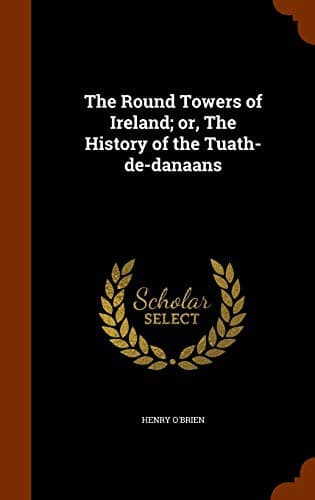
The Round Towers of Ireland; or, The History of the Tuath-De-DanaansO'Brien, Henry
Religion
The Round Towers of Ireland; or, The History of the Tuath-De-Danaans
O'Brien, Henry
Ireland -- Antiquities; Round towers -- Ireland
Lord, from the Shaster, quotes the following abstract, marking the opinion
of the Easterns themselves, as to Adam and Eve having had many
contemporaries. This relates an interview between a different couple.
“Being both persuaded that God had a hand in this their meeting, they took
council from this book, to bind themselves in the inviolable bond of
marriage, and with the courtesies interceding between man and wife, were
lodged in one another’s bosoms: for joy whereof the sun put on his nuptial
lustre, and looked brighter than ordinary, causing the season to shine
upon them with golden joy; and the silver moon welcomed the evening of
their repose, whilst music from heaven, as if God’s purpose in them had
been determinate, sent forth a pleasing sound, such as useth to fleet from
the loud trumpet, together with the noise of the triumphant drum. Thus
proving the effects of generation together, they had fruitful issue, and
so peopled the East, and the woman’s name was Sanatree.”
This _Maypole_ ceremony, under the name of _Phallica_, _Dionysia_, or
_Orgia_, which last word, though sometimes applied to the mysteries of
other deities, belongs more particularly to those of Bacchus,[254] was
celebrated, at one time, throughout Attica with all the extravagance of
religio-lascivious pomp. Archer, in his _Travels in Upper India_, arrived
at a village just a few hours only after the May gaieties were over, and
found the _pole_ still standing. “The occasion,” says he, “was one of
festivity, for all had strings of flowers about their heads, and they
spoke of the matter as one of great pleasure and amusement.” As, however,
he did not come in for the actual observances, I shall supply the omission
by detailing the form of its celebration in our own country.
“Anciently,” says M’Skimin, in his _History of Carrickfergus_, “a large
company of young men assembled each May-day, who were called May-boys.
They wore above their other dress white linen shirts, which were covered
with a profusion of various coloured ribbons, formed into large and
fantastic knots. One of the party was called King, and the other Queen,
each of whom wore a crown, composed of the most beautiful flowers of the
season, and was attended by pages who held up the train. When met, their
first act was _dancing to music round the pole_, planted the preceding
evening; after which they went to the houses of the most respectable
inhabitants round about, and having taken a short jig in front of each
house, received a voluntary offering from those within. The sum given was
rarely less than five shillings. In the course of this ramble the King
always presented a rich garland of flowers to some handsome young woman,
who was hence called ‘the Queen of May’ till the following year.”
Public-domain text, read in full here on John Shaqi.
Reviews
Reviews
No reviews yet
Be the first to share your thoughts on this work.
Elsewhere in the archive
Join the Discussion
Join the discussion
Sign in to leave a comment or review.
Sign InorCreate an account