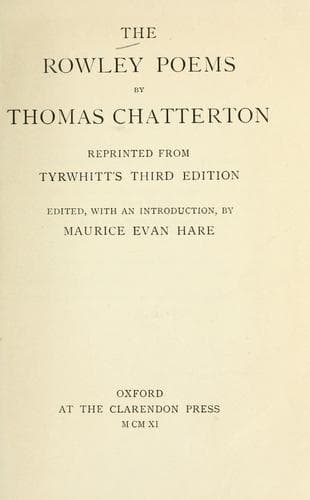
English poetry -- 18th century; Literary forgeries and mystifications -- Early works to 1800
When these Poems were first printed, it was thought best to leave the
question of their authenticity to the determination of the impartial
Public. The Editor contented himself with intimating his opinion,
[Pref. p. xii, xiii.] that the external evidence on both sides was
so defective as to deserve but little attention, and that the final
decision of the question must depend upon the internal evidence. To
shew that this opinion was not thrown out in order to mislead the
enquiries and judgements of the readers, I have here drawn together
_some observations upon_ THE LANGUAGE[1] _of the poems attributed to
Rowley_, which, I think, will be sufficient to prove, 1st, that they
were not written in the XV Century; and 2dly, that they were written
entirely by Thomas Chatterton.
The proof of the second proposition would in effect carry with it that
of the first; but, notwithstanding. I choose to treat them separately
and to begin with the first.
I shall premise only one _postulatum_, which is, that Poets of the
same age and country use the same language, allowances being made for
certain varieties, which may arise from the local situation, the rank
in life, the learning, the affectation of the writers, and from the
different subjects and forms of their compositions [2].
This being granted, I have nothing to do but to prove, that the
language of the poems attributed to Rowley (when every proper
allowance has been made) is totally different from that of the other
English writers of the XV Century, in many material particulars. It
would be too tedious to go through them all; and therefore I shall
only take notice of such as can be referred to three general heads;
the _first_ consisting of words not used by any other writer; the
_second_, of words used by other writers, but in a different sense;
and the _third_, of words inflected in a manner contrary to grammar
and custom.
Under the _first_ head I would recommend the following words to the
reader's consideration.
1. ABESSIE. E. III. 89.
Whylest the congeon flowrette _abessie_ dyghte.
2. ABORNE. T. 45.
Snett oppe hys long strunge bowe and sheelde _aborne_.
3. ABREDYNGE. Æ 334.
Agylted Ælla, thie _abredynge_ blynge.
4. ACROOLE. El. 6.
Didde speke _acroole_, wythe languishment of eyne.
5. ADAVE. H. 2. 392.
The fynest dame the Sun or moon _adave_.
6. ADENTE. Æ 396. ADENTED. G. 32.
Ontoe thie veste the rodde sonne ys _adente_.
_Adented_ prowess to the gite of witte.
7. ADRAMES. Ep. 27.
Loughe loudlie dynneth from the dolte _adrames_.
8. ALATCHE. Æ 117.
Leave me swythe or I'lle _alatche_.
9. ALMER. Ch. 20.
Where from the hail-stone coulde the _almer_ flie?
10. ALUSTE. H. 1. 88.
That Alured coulde not hymself _aluste_.
11. ALYNE. T. 79.
Wythe murther tyred he flynges hys bowe _alyne_.
Public-domain text, read in full here on John Shaqi.
Reviews
Reviews
No reviews yet
Be the first to share your thoughts on this work.
Elsewhere in the archive
Join the Discussion
Join the discussion
Sign in to leave a comment or review.
Sign InorCreate an account