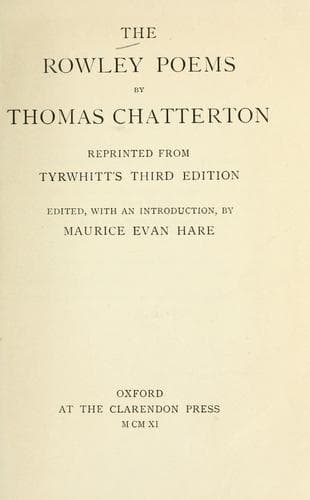
English poetry -- 18th century; Literary forgeries and mystifications -- Early works to 1800
12. ALYSE. Le. 29.--G. 180.
Somme dryblette share you shoulde to that _alyse_.
Fulle twentie mancas I wylle thee _alise_.
13. ANERE. Æ 15.--Ep. 48.
And cann I lyve to see herr wythe _anere_?
----Adieu untylle _anere_.
14. ANETE. p. 281. 64.
Whych yn the blosom woulde such sins _anete_.
15. APPLINGS. E. I. 33.
Mie tendre _applynges_ and embodyde trees.
16. ARROW-LEDE. H. 1. 74.
Han by his soundynge _arrowe-lede_ bene sleyne.
17. ASENGLAVE. H. 1. 117.
But Harold's _asenglave_ stopp'd it as it flewe.
18. ASLEE. Æ 504.
That doest _aslee_ alonge ynn doled dystresse.
19. ASSWAIE. Æ 352.
Botte thos to leave thee, Birtha, dothe _asswaie_
Moe torturynge peynes, &c.
20. ASTENDE. G. 47.
Acheke the mokie aire and heaven _astende_.
I stop here, not because the other Letters of the alphabet would not
afford a proportionable number of words which might be referred to
this head, but because I think these sufficient for my purpose. I
proceed therefore to set down an equal number of words under the
_second_ general head.
1. ABOUNDE. H. 1. 55.
His cristede beaver dyd him smalle _abounde_.
The common sense of _Abound_, a verb, is well known; but what can be
the meaning of it here?
2. ALEDGE. G. 5.
Lette notte thie agreme blyn ne _aledge_ stonde.
_Aledge_, or _Alege_, v. Fr. in Chaucer signifies _to alleviate_.
It is here used either as an adjective or as an adverb. Chatterton
interprets it to mean _idly_; upon what ground I cannot guess.
3. ALL A BOON. E. III. 41.--p. 23. l. 4.
_All-a-boon_, fyr Priest, _all-a-boon_.
Thys ys the onelie _all-a-boone_ I crave.
Here are three English words, the sense of which, taken separately,
is clear. As joined together in this passage they are quite
unintelligible.
4. ALLEYN. E. I. 52.
Mie sonne, mie sonne _alleyn_ ystorven ys.
Granting _alleyn_ to be rightly put for alone, no ancient writer, I
apprehend, ever used such a phrase as this; any more than we should
now say--_my son alone_ for _my only son_. 5. ASCAUNCE. E. III. 52.
Lokeynge _ascaunce_ upon the naighboure greene.
The usual sense of _ascaunce_ in Chaucer, and other old writers, has
been explained in a note on ver. 7327. of the Canterbury Tales. It
is used in the same sense by Gascoigne. The more modern adverb
_ascaunce_, signifying _sideways, obliquely_, is derived from the
Italian _a schiancio_, and I doubt very much whether it had been
introduced into the English language in the time of the supposed
Rowley.
6. ASTERTE. G. 137.
----You have theyr worthe _asterte_.
I despair of finding any authorized sense of the word _asterte_, that
will suit this passage. It cannot, I think, signifie _neglected or
passed by_, as Chatterton has rendered it.
7. AUMERE. Æ. 398.--Ch. 7. AUMERES. E. III. 25.
Public-domain text, read in full here on John Shaqi.
Reviews
Reviews
No reviews yet
Be the first to share your thoughts on this work.
Elsewhere in the archive
Join the Discussion
Join the discussion
Sign in to leave a comment or review.
Sign InorCreate an account