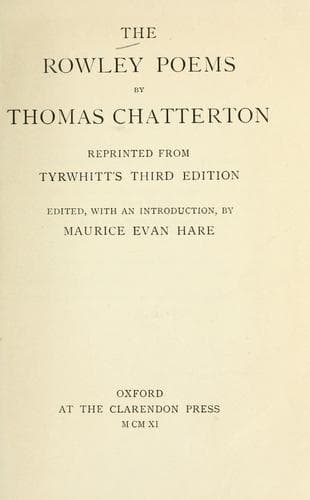
English poetry -- 18th century; Literary forgeries and mystifications -- Early works to 1800
Ch. 54. Full well it _shewn_, he _thoughten_ coste no sinne.
See also H. 2. 366. where _thoughten_, with the additional syllable,
not being quite long enough for the verse, has had another syllable
added at the beginning.
Ne onne abash'd _enthoughten_ for to flee.
And (what is still more curious) we have a participle of the present
tense formed from this fictitious past time, in Æ. 704.
_Enthoughteyng_ for to scape the _brondeynge_ foe--
Which would not have been a bit more intelligible in the XV Century
than it would be now. _Brondeynge_ will be taken notice of below.
Many other instances of the most unwarrantable anomalies might be
produced under this head; but I think I have said enough to prove,
that the language of these poems is totally different from that of the
other English writers of the XV Century; and consequently that they
were not written in that century; which was my first, proposition. I
shall now endeavour to prove, from the same internal evidence of the
language, that they were written entirely by Thomas Chatterton.
For this purpose it will only be necessary to have recourse to those
interpretations of words by way of Glossary, which were confessedly
written by him[4]. It will soon appear, if I am not much mistaken,
that the author of the Glossary was the author of the Poems.
Whoever will take the pains to examine these interpretations will
find, that they are almost all taken from SKINNER'S _Etymologicon
Linguæ Anglicanæ_[5]. In many cases, where the words are really
ancient, the interpretations are perfectly right; and so far
Chatterton can only be considered in the light of a commentator, who
avails himself of the best assistances to explane any genuine author.
But in many other instances, where the words are either not ancient
or not used in their ancient sense, the interpretations are totally
unfounded and fantastical; and at the same time the words cannot be
altered or amended consistently with any rules of criticism, nor can
the interpretations be varied without destroying the sense of
the passage. In these cases, I think, there is a just ground for
believing, that the words as well as their interpretations came from
the hand of Chatterton, especially as they may be proved very often to
have taken their rise either from blunders of Skinner himself, or from
such mistakes and misapprehensions of his meaning as Chatterton, from
haste and ignorance, was very likely to fall into.
I will state first some instances of words and interpretations which
have evidently been derived from blunders of Skinner.
ALL A BOON. E. III. 41. See before, p. 315. _A manner of asking a
favour_, says Chatterton.
Now let us hear Skinner.
"=All a bone=, exp. Preces, Supplex Libellus, Supplicatio, vel ut jam
loquimur Petitio viro Principi exhibita, ni fallor ab AS. Bene, unde
nostrum _Boon_ additis particulis Fr. G. A _la_. Ch. Fab. Mercatoris
fol. 30. p. i. Col. 2."
Public-domain text, read in full here on John Shaqi.
Reviews
Reviews
No reviews yet
Be the first to share your thoughts on this work.
Elsewhere in the archive
Join the Discussion
Join the discussion
Sign in to leave a comment or review.
Sign InorCreate an account