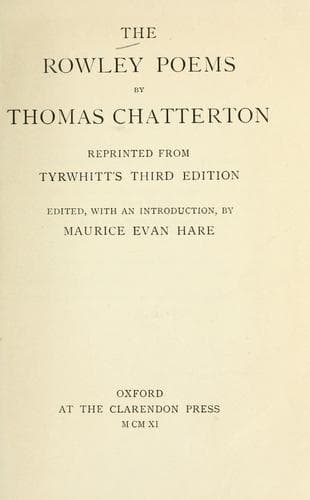
English poetry -- 18th century; Literary forgeries and mystifications -- Early works to 1800
I cannot believe that _thyssen_ was ever in use as the plural number
of _this_. The termination seems to have been added, for the sake of
the metre, by one who knew that many words formerly ended in _en_,
but was quite ignorant of what particular sorts they were. In the same
manner _coyen_, Æ. 125. and _sothen_, Æ. 227. are put for _coy_ and
_sothe_, contrary to all usage or analogy.
And this leads me to the capital blunder, which runs through all these
poems, and would alone be sufficient to destroy their credit; I mean,
the termination of _verbs in the singular number_ in _n_[3]. I will
set down a number of instances, in which _han_ is used for the present
or past time _singular_ of the v. _Have_; only premising, that _han_,
being an abbreviation of _haven_, is never used by any ancient writer
except in the present time _plural_ and the infinitive mode.
P. 26. v. 9. The Brytish Merlyn oftenne _hanne_
The gyfte of inspyration.
Ba. 2. The featherd songster chaunticleer
_Han_ wounde hys bugle horne.
Æ. 685. Echone wylle wyssen hee _hanne_ seene the daie.
734. Bryghte sonne _han_ ynne hys roddie robes byn dyghte.
650. Whanne Englonde _han_ her foemenn.
1137. ----Mie stede _han_ notte mie love.
1184. _Hanne_ alle the fuirie of mysfortunes wylle
Fallen onne mie benned headde I _hanne_ been Ælla stylle.
G. 20. _Hane_ Englonde thenne a tongue butte notte a stynge?
M. 61. A tye of love a dawter faire she _hanne_.
H. 1. 74. Ne doubting but the bravest in the londe
_Han_ by his foundynge arrowe-lede bene sleyne.
182. Where he by chance _han_ slayne a noble's son.
184. And in the battel he much goode _han_ done.
188. He of his boddie _han_ kepte watch and ward.
207. His chaunce in warr he ne before _han_ tryde.
281. The erlie felt de Torcies trecherous knyfe
_Han_ made his crymson bloude and spirits floe.
319. O Hengist, _han_ thy cause bin good and true!
321. The erlie was a manne of hie degree.
And _han_ that daie full manie Normannes sleine.
337. But better _han_ it bin to lett alone.
If more instances should be wanted, see H. 1. 396. 429. 455. H. 2.
306. 703.--p. 275. ver. 4.--p. 281. ver. 63.--p. 288. ver. 1.
In the same irregular manner the following verbs are used
_singularly_.
E. I. 10. Then _fellen_ on the grounde and thus yspoke.
H. 2. 665. Bewopen Alfwoulde _fellen_ on his knee.
P. 287. ver. 17. For thee I _gotten_ or bie wiles or breme.
H. 1. 252. He turned aboute and vilely _souten_ flie.
H. 2. 339. Fallyng he _shooken_ out his smokyng braine.
H. 2. 334. His sprite--Ne _shoulden_ find a place in anie songe.
Æ. 172. So Adam _thoughtenne_ when ynn paradyse----
1136. Tys now fulle morne; I _thoughten_, bie laste nyghte--
Public-domain text, read in full here on John Shaqi.
Reviews
Reviews
No reviews yet
Be the first to share your thoughts on this work.
Elsewhere in the archive
Join the Discussion
Join the discussion
Sign in to leave a comment or review.
Sign InorCreate an account