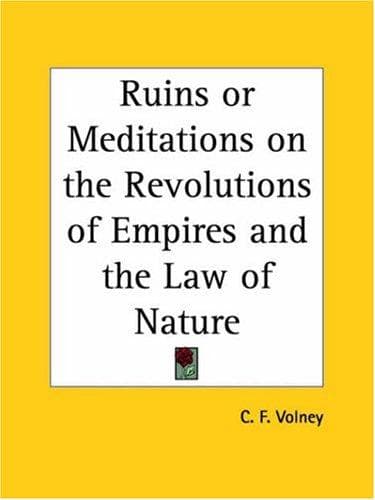
The Ruins; Or, Meditation on the Revolutions of Empires and the Law of NatureVolney, C.-F. (Constantin-François)
Religion
The Ruins; Or, Meditation on the Revolutions of Empires and the Law of Nature
Volney, C.-F. (Constantin-François)
Ethics; History -- Philosophy; Religions; Revolutions
Its geographical position was favorable to this twofold
object. For, on one side, the valley of the Nile, singularly
fertile, must have early occasioned a numerous population;
and, on the other, the Red Sea, giving communication with
Arabia and India, and the Nile with Abyssinia and the
Mediterranean, Thebes was thus naturally allied to the
richest countries on the globe; an alliance that procured it
an activity so much the greater, as Lower Egypt, at first a
swamp, was nearly, if not totally, uninhabited. But when at
length this country had been drained by the canals and dikes
which Sesostris constructed, population was introduced
there, and wars arose which proved fatal to the power of
Thebes. Commerce then took another route, and descended to
the point of the Red Sea, to the canals of Sesostris (see
Strabo), and wealth and activity were transferred to
Memphis. This is manifestly what Diodorus means when he
tells us (lib. i. sect. 2), that as soon as Memphis was
established and made a wholesome and delicious abode, kings
abandoned Thebes to fix themselves there. Thus Thebes
continued to decline, and Memphis to flourish, till the time
of Alexander, who, building Alexandria on the border of the
sea, caused Memphis to fall in its turn; so that prosperity
and power seem to have descended historically step by step
along the Nile; whence it results, both physically and
historically, that the existence of Thebes was prior to that
of the other cities. The testimony of writers is very
positive in this respect. "The Thebans," says Diodorus,
"consider themselves as the most ancient people of the
earth, and assert, that with them originated philosophy and
the science of the stars. Their situation, it is true, is
infinitely favorable to astronomical observation, and they
have a more accurate division of time into mouths and years
than other nations" etc.
Public-domain text, read in full here on John Shaqi.
Reviews
Reviews
No reviews yet
Be the first to share your thoughts on this work.
Join the Discussion
Join the discussion
Sign in to leave a comment or review.
Sign InorCreate an account