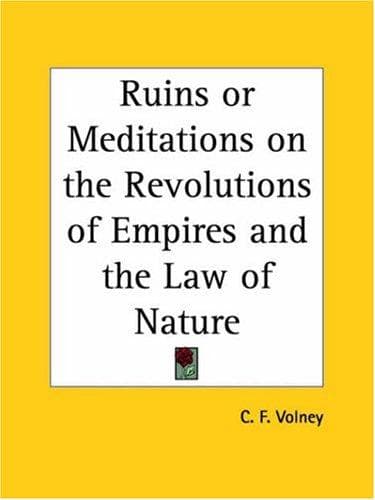
The Ruins; Or, Meditation on the Revolutions of Empires and the Law of Nature — John Shaqi
The Ruins; Or, Meditation on the Revolutions of Empires and the Law of NatureVolney, C.-F. (Constantin-François)
Religion
The Ruins; Or, Meditation on the Revolutions of Empires and the Law of Nature
Volney, C.-F. (Constantin-François)
Ethics; History -- Philosophy; Religions; Revolutions
** In Persia, after the death of Thamas-Koulikan, each
province had its chief, and for forty years these chiefs
were in a constant state of war. In this view the Turks do
not say without reason: "Ten years of a tyrant are less
destructive than a single night of anarchy."
Oh! if there were on earth men profound and bold! what elements for
grandeur and glory! But the hour of destiny has already come; the cry of
war strikes my ear; and the catastrophe begins. In vain the Sultan leads
forth his armies; his ignorant warriors are beaten and dispersed. In
vain he calls his subjects; their hearts are ice. Is it not written? say
they, what matters who is our master? We cannot lose by the change.
In vain the true believers invoke heaven and the prophet. The prophet is
dead; and heaven without pity answers:
Cease to invoke me. You have caused your own misfortunes; cure them
yourselves. Nature has established laws; your part is to obey them.
Observe, reason, and profit by experience. It is the folly of man which
ruins him; let his wisdom save him. The people are ignorant; let them
gain instruction. Their chiefs are wicked; let them correct and amend;
for such is Nature's decree. Since the evils of society spring from
cupidity and ignorance, men will never cease to be persecuted, till they
become enlightened and wise; till they practise justice, founded on a
knowledge of their relations and of the laws of their organization.*
* A singular moral phenomenon made its appearance in Europe
in the year 1788. A great nation, jealous of its liberty,
contracted a fondness for a nation the enemy of liberty; a
nation friendly to the arts, for a nation that detests them;
a mild and tolerant nation, for a persecuting and fanatic
one; a social and gay nation, for a nation whose
characteristics are gloom and misanthropy; in a word, the
French were smitten with a passion for the Turks: they were
desirous of engaging in a war for them, and that at a time
when revolution in their own country was just at its
commencement. A man, who perceived the true nature of the
situation, wrote a book to dissuade them from the war: it
was immediately pretended that he was paid by the
government, which in reality wished the war, and which was
upon the point of shutting him up in a state prison. Another
man wrote to recommend the war: he was applauded, and his
word taken for the science, the politeness, and importance
of the Turks. It is true that he believed in his own
thesis, for he has found among them people who cast a
nativity, and alchymists who ruined his fortune; as he found
Martinists at Paris, who enabled him to sup with Sesostris,
and Magnetizers who concluded with destroying his existence.
Notwithstanding this, the Turks were beaten by the Russians,
and the man who then predicted the fall of their empire,
Public-domain text, read in full here on John Shaqi.
Reviews
Reviews
No reviews yet
Be the first to share your thoughts on this work.
Join the Discussion
Join the discussion
Sign in to leave a comment or review.
Sign InorCreate an account