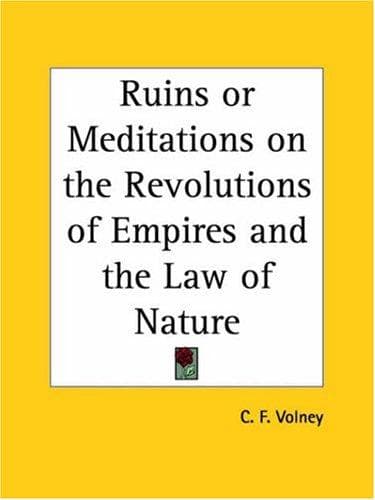
The Ruins; Or, Meditation on the Revolutions of Empires and the Law of Nature — John Shaqi
The Ruins; Or, Meditation on the Revolutions of Empires and the Law of NatureVolney, C.-F. (Constantin-François)
Religion
The Ruins; Or, Meditation on the Revolutions of Empires and the Law of Nature
Volney, C.-F. (Constantin-François)
Ethics; History -- Philosophy; Religions; Revolutions
Believe, young man, the testimony of monuments, and the voice of the
tombs. Some countries have doubtless fallen from what they were at
certain epochs; but if we weigh the wisdom and happiness of their
inhabitants, even in those times, we shall find more of splendor than of
reality in their glory; we shall find, in the most celebrated of ancient
states, enormous vices and cruel abuses, the true causes of their
decay; we shall find in general that the principles of government
were atrocious; that insolent robberies, barbarous wars and implacable
hatreds were raging from nation to nation;* that natural right was
unknown; that morality was perverted by senseless fanaticism and
deplorable superstition; that a dream, a vision, an oracle, were
constantly the causes of vast commotions. Perhaps the nations are not
yet entirely cured of all these evils; but their intensity at least is
diminished, and the experience of the past has not been wholly lost. For
the last three centuries, especially, knowledge has increased and been
extended; civilization, favored by happy circumstances, has made a
sensible progress; inconveniences and abuses have even turned to its
advantage; for if states have been too much extended by conquest,
the people, by uniting under the same yoke, have lost the spirit of
estrangement and division which made them all enemies one to the other.
If the powers of government have been more concentrated, there has been
more system and harmony in their exercise. If wars have become more
extensive in the mass, they are less bloody in detail. If men have gone
to battle with less personality, less energy, their struggles have been
less sanguinary and less ferocious; they have been less free, but less
turbulent; more effeminate, but more pacific. Despotism itself has
rendered them some service; for if governments have been more absolute,
they have been more quiet and less tempestuous. If thrones have become
a property and hereditary, they have excited less dissensions, and the
people have suffered fewer convulsions; finally, if the despots, jealous
and mysterious, have interdicted all knowledge of their administration,
all concurrence in the management of public affairs, the passions
of men, drawn aside from politics, have fixed upon the arts, and the
sciences of nature; and the sphere of ideas in every direction has been
enlarged; man, devoted to abstract studies, has better understood his
place in the system of nature, and his relations in society; principles
have been better discussed, final causes better explained, knowledge
more extended, individuals better instructed, manners more social, and
life more happy. The species at large, especially in certain countries,
has gained considerably; and this amelioration cannot but increase in
future, because its two principal obstacles, those even which, till
then, had rendered it slow and sometimes retrograde,--the difficulty of
Public-domain text, read in full here on John Shaqi.
Reviews
Reviews
No reviews yet
Be the first to share your thoughts on this work.
Join the Discussion
Join the discussion
Sign in to leave a comment or review.
Sign InorCreate an account