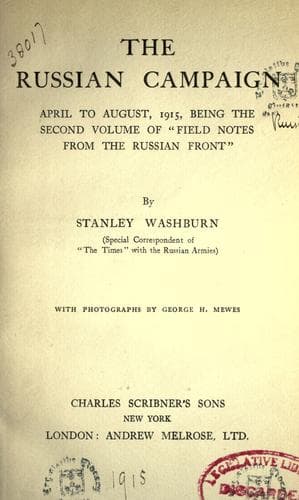
The Russian Campaign, April to August, 1915: Being the Second Volume of "Field Notes from the Russian Front"Washburn, Stanley
History
The Russian Campaign, April to August, 1915: Being the Second Volume of "Field Notes from the Russian Front"
Washburn, Stanley
World War, 1914-1918 -- Campaigns -- Eastern Front; World War, 1914-1918 -- Personal narratives
The army of the Bukovina, or the extreme Russian left, is probably the
most romantic organization operating in one of the most picturesque
countries in the whole theatre of this gigantic war. In the first place
the left is composed very largely of the type of cavalry which I think
no other country in the world can duplicate, that is the irregular
horsemen brought from all parts of the East. Tribes from the Caucasus,
Tartars, Mongols, and I know not what others, are here welded together
into brigades and divisions, and make, all told, nearly two complete
army corps with only a sprinkling of infantry and regular cavalry.
It was this army that gained such headway in its advance toward the
Hungarian plain, and it is this very army that is credited with so
alarming the Hungarians that they threatened independent peace unless
something was done for them. That something we know now was Austria’s
wail to Germany and the resulting Galician campaign.
During all the first part of the great German drive, this army with
its hordes of wild cavalry was proceeding confidently “hacking its way
through” all resistance, and capturing thousands upon thousands of
Austrians or Hungarians that came in its way. For nearly a month after
things were going badly in the West, it was moving victoriously forward
until it became evident that unless it stopped it would find itself an
independent expedition headed for Buda-Pest and completely out of touch
with the rest of the Russian line which was withdrawing rapidly. Then
came a pause, and as the flanking armies continued to retreat, the army
was very unwillingly obliged to retire also to keep in touch with its
neighbour. My own impression as to the spirits of this army, especially
of the cavalry corps, is similar to the impression one forms when one
sees a bulldog being let loose from another hound whom he has down,
and is chewing luxuriously when his master comes along, and drags him
away on a leash. So these troops have retired snarling and barking over
their shoulders, hoping that the enemy would follow close enough to let
them have another brush with them.
[Illustration: G. H. Mewes.]
Public-domain text, read in full here on John Shaqi.
Reviews
Reviews
No reviews yet
Be the first to share your thoughts on this work.
Elsewhere in the archive
Join the Discussion
Join the discussion
Sign in to leave a comment or review.
Sign InorCreate an account