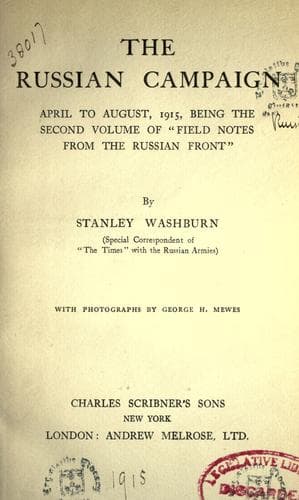
The Russian Campaign, April to August, 1915: Being the Second Volume of "Field Notes from the Russian Front"Washburn, Stanley
History
The Russian Campaign, April to August, 1915: Being the Second Volume of "Field Notes from the Russian Front"
Washburn, Stanley
World War, 1914-1918 -- Campaigns -- Eastern Front; World War, 1914-1918 -- Personal narratives
There has been fighting of more or less acuteness, especially where
German troops have been engaged, but taken on the whole this portion
of the Russian front cannot be considered a serious one and their
withdrawal has been forced by the greater strategy. I found many of
the younger officers of the opinion that they could advance at any
time if they only had the permission from the powers that be. As for
the soldiers--a single look into those set swarthy faces was enough to
satisfy one that they would willingly advance in any event regardless
of policy or orders either. I have never seen such fierce looking men
in my life. Many of them do not speak Russian, and to them the war
is a real joy. Heretofore they have had to be content to fight among
themselves for nothing in particular; now that they have a chance
to fight for something really great they are in their element. I
question how valuable troops of this character would be under different
conditions, but here in this rough Bukovina country they are nearly
ideal for their work, as is manifest from the manner in which they have
swept the enemy before them.
On leaving Tarnopol we came directly to the head-quarters of one of
these corps, where we spent three extremely interesting days. The
position which this army was holding is, in a rough way, from the
junction of the Zota Lipa and the Dniester, down that river to a point
perhaps 20 versts west of Chocin, and thence in an irregular line
40 or 50 versts through Bukovina in the direction of the Roumanian
frontier. The Dniester itself is a deep-flowing river lying between
great bluffs which for miles skirt the river bank on both sides. These
bluffs are for the most part crested with heavy timber. In a general
way the Russians are holding one bank, and the Austrians the other,
though here and there patches of Russians have clung to the South side,
while in one or two spots Austrians backed by Germans have gained a
foothold on the north bank. The first afternoon I arrived, I went out
to a 356 metre hill from where I could look over the whole country.
I discerned easily the lines of the Austrian and Russian positions
between which was the valley through which flowed the Dniester. There
are any number of young Petrograd swells here who have left their
crack cavalry corps, many of which are dismounted and fighting in the
trenches in Poland and on other fronts, to put on the uniform of the
Cossack and lead these rough riders of the East in their romantic
sweeps towards the Hungarian plains. I have been in some armies where I
found hardly any one who spoke English, but in this one corps I found
nearly a score who spoke it, many as well as I did, which indicates
pretty clearly the type of young men that Russia has here, and is
one reason, no doubt, why the army has done so well.
[Illustration: Stanley Washburn, Prince Oblensky, Count Tolstoy, Count
Keller.]
Public-domain text, read in full here on John Shaqi.
Reviews
Reviews
No reviews yet
Be the first to share your thoughts on this work.
Elsewhere in the archive
Join the Discussion
Join the discussion
Sign in to leave a comment or review.
Sign InorCreate an account