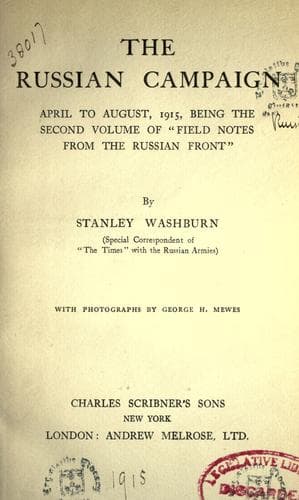
The Russian Campaign, April to August, 1915: Being the Second Volume of "Field Notes from the Russian Front" — John Shaqi
The Russian Campaign, April to August, 1915: Being the Second Volume of "Field Notes from the Russian Front"Washburn, Stanley
History
The Russian Campaign, April to August, 1915: Being the Second Volume of "Field Notes from the Russian Front"
Washburn, Stanley
World War, 1914-1918 -- Campaigns -- Eastern Front; World War, 1914-1918 -- Personal narratives
[Illustration: Austrian and Hungarian prisoners en route to Lwow.]
From Lwow almost due west runs the line of the highway to Grodek
where we get our first glimpse of prisoners in bulk. Here, at the
scene of some of the fiercest fighting that the war has produced, is
a rest station for the columns that are making the journey to Russian
captivity on foot from Przemysl to Lwow, and I know not how far beyond.
As we motor into the town the three battalions of the 9th Hungarian
regiment of the 54th Landsturm brigade are just straggling into the
town from the west. With a few Russians who seem to be acting as guides
and nurses rather than as guards, they file through the streets and
into a great square of a barracks. Here they are marshalled in columns
of four, and marched past the door of the barracks where an official
counts the individual fours and makes a note of the number that have
passed his station. Beyond in a grove the ranks are broken, and the
weary-looking men drop down under the trees, regardless of the snow and
mud, and shift their burdens and gnaw at the hunks of bread and other
provisions furnished them by the Russians.
It is hard to realize that the haggard despondent rabble that we see
has ever been part of an actual army in being. Most of them were
evidently clothed for a summer campaign, and their thin and tattered
uniform overcoats must have given but scant warmth during the winter
that has passed. The line is studded with civilian overcoats, and
many of the prisoners have only a cap or a fragment of a uniform
which identifies them as ever having been soldiers at all. The women
of the village pass up and down the line giving the weary troops
bits of provision not in the Russian menu. All the men are wan and
thin, with dreary hopelessness written large upon their faces, and a
vacant stare of utter desolation in their hollow eyes. They accept
gladly what is given and make no comment. They get up and sit down as
directed by their guards, apparently with no more sense of initiative
or independence of will than the merest automatons. We pause but a few
minutes, for the roads are bad and we are anxious to get over the muddy
way as quickly as possible.
The western portion of Grodek was badly knocked up by shell fire during
the battle in September, and the barren walls of charred buildings
remain to tell the story of the Austrian effort to stay the tide of the
Russian advance that swept them out of position after position during
the first weeks of the war. Grodek was reported to have been utterly
destroyed at the time, but as a fact, not more than one-fifth of the
buildings were even damaged by the artillery fire.
[Illustration: Austrian prisoners resting by the roadside during their
march from Przemysl.]
Public-domain text, read in full here on John Shaqi.
Reviews
Reviews
No reviews yet
Be the first to share your thoughts on this work.
Join the Discussion
Join the discussion
Sign in to leave a comment or review.
Sign InorCreate an account