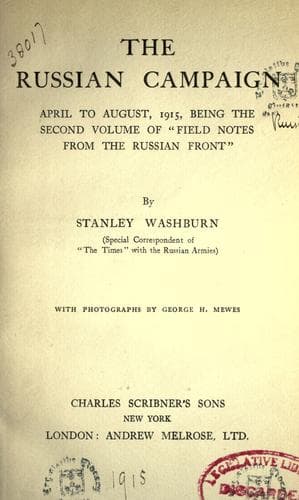
The Russian Campaign, April to August, 1915: Being the Second Volume of "Field Notes from the Russian Front"Washburn, Stanley
History
The Russian Campaign, April to August, 1915: Being the Second Volume of "Field Notes from the Russian Front"
Washburn, Stanley
World War, 1914-1918 -- Campaigns -- Eastern Front; World War, 1914-1918 -- Personal narratives
During the retreat from Stryj to the Zota Lipa, where the army was when
I visited it, captures of enemy prisoners were made to the number of
53,000, as I was informed by the highest authority. The bulk of these
were Austrians. As I said at the time, I incline to think this must be
considered one of the most remarkable retreats in history. If I was
disposed to doubt this statement when I first heard it, my hesitation
vanished, when, during three days, I personally saw between 4,000 and
5,000 Austrian prisoners that had been taken within a week, regardless
of the fact that the army was still retiring before the enemy. I
think that the mere mention of the matter of prisoners is enough to
convince the reader that this army was not a demoralized one, and that
the furthest stretch of imagination could not consider it a badly
defeated one. A glance at the map serves to show that the country,
from the beginning of this retreat to the Zota Lipa, is an ideal one
in which to fight defensively! and as a matter of fact the country for
100 versts further east is equally well adapted to the same purpose.
A number of streams running almost due north and south flow into the
Dniester river, and as each of these rivulets runs between more or less
pretentious bluffs it is a very simple matter to hold them with very
little fieldworks.
What the Russians have been doing here is this. They take up one of
these natural lines of defence and throw up temporary works on the
bluffs and wait for the Austrians. When the latter come up they find
the Russians too strong to be turned out with anything short of the
full enemy strength. Usually a week is taken up by the Austro-German
forces in bringing up their full strength, getting their guns in
position and preparing for an attack. The Russians in the meantime sit
on their hills, taking all the losses that they can get, and repel the
Austrian preliminary attacks as long as they can do so without risking
too much. By the time that enemy operations have reached a really
serious stage, and an attack in force is made, it is discovered that
the main force of the Russians has departed, and when the positions
are finally carried, only a rearguard of cavalry is discovered holding
the trenches; the bulk of these usually get away on their horses,
leaving the exhausted Austrians sitting in a hardly-won line with
the knowledge that the Russians are already miles away waiting for
them to repeat the operation all over again. The prisoners have been
captured for the most part in preliminary operations on these works,
on occasions where the Russians have made counter attacks or where
the Austrians have advanced too far and been cut off. The youth and
inexperience of their officers, and the fact that the rank and file
have no heart in the fight, have made it easy for them to go too far
in the first place, and willing to surrender without a fight when
they discover their mistake. All of this I was told at head-quarters,
Public-domain text, read in full here on John Shaqi.
Reviews
Reviews
No reviews yet
Be the first to share your thoughts on this work.
Elsewhere in the archive
Join the Discussion
Join the discussion
Sign in to leave a comment or review.
Sign InorCreate an account