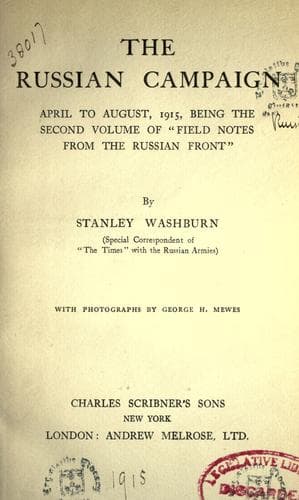
The Russian Campaign, April to August, 1915: Being the Second Volume of "Field Notes from the Russian Front"Washburn, Stanley
History
The Russian Campaign, April to August, 1915: Being the Second Volume of "Field Notes from the Russian Front"
Washburn, Stanley
World War, 1914-1918 -- Campaigns -- Eastern Front; World War, 1914-1918 -- Personal narratives
and had an opportunity to verify the next day by going to one of the
forward positions on the Zota Lipa.
I have within the last few months, after poking about on the billiard
table terrain of the Polish Front, acquired a great liking for hills,
protected by woods if possible. I have therefore picked places on this
trip where I could get to points of observation from which I could
see the terrain without being, shot at, if this could be avoided with
dignity. It was just such a place as this towards which we headed
the next day. My own impressions were, and still are, that this army
might retire further yet from its present positions. There are certain
reasons which I cannot divulge at present, but are no doubt understood
in England, that makes it unwise for these armies to attempt to hold
advance positions if they can fall quietly back without the sacrifice
of any positions which will have a bad effect on the Russian campaign
as a whole. This particular army with its neighbour to the south can
do this for more than 100 versts without materially impairing its own
_moral_, and, as far as I can see, without giving the enemy any other
advantage than something to talk about.
On the way out to the positions I passed important bodies of troops
“changing front,” for it is hardly possible to call what I witnessed,
a retreat. They came swinging down the road laughing, talking and
then singing at the top of their lungs. Had I not known the points of
the compass, I should have concluded that they had scored a decisive
victory and were marching on the capital of the enemy. But of such
stuff are the moujik soldiers of the Czar.
We first visited the head-quarters of one of the Army corps, and then
motored through Ztoczow, a very beautiful little Austrian town lying
just at the gateway between ridges of hills that merge together as they
go eastward, making the road climb to the plateau land which, indented
by the valleys of the rivers running into the Dniester, stretches
practically for 100 versts east of here. Turning south from the little
town we climbed up on to this plateau land, and motored for 15 or 20
versts south to the head-quarters of a General commanding a division
of Cossack cavalry from the Caucasus. With him we had tea, and as he
spoke excellent English I was able to gather much of interest from his
point of view. He was not sufficiently near head-quarters nor of rank
high enough to be taken into the higher councils, and therefore did
not know the reasons for the constant retirements. Again and again he
assured me that the positions now held could as far as he was concerned
be retained indefinitely. His was the thankless job of the rear guard,
and it apparently went against his fighting instincts to occupy these
splendid positions and then retire through some greater strategy, which
he, far off in the woods from everything, did not understand.
Public-domain text, read in full here on John Shaqi.
Reviews
Reviews
No reviews yet
Be the first to share your thoughts on this work.
Elsewhere in the archive
Join the Discussion
Join the discussion
Sign in to leave a comment or review.
Sign InorCreate an account