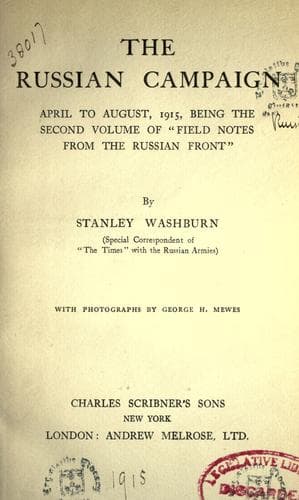
The Russian Campaign, April to August, 1915: Being the Second Volume of "Field Notes from the Russian Front"Washburn, Stanley
History
The Russian Campaign, April to August, 1915: Being the Second Volume of "Field Notes from the Russian Front"
Washburn, Stanley
World War, 1914-1918 -- Campaigns -- Eastern Front; World War, 1914-1918 -- Personal narratives
Without weakening for a moment their attacks on their main objectives,
they began (with new reinforcements) to spear about for a point against
which to launch still a third attack. Several attempts disclosed the
Russians in strength, but at last the enemy discovered that the weakest
spot was on the Vistula south of Warsaw. As this was the easiest to
defend on account of the river being approximately the line, the
Russians had fewer troops and thus the Germans were able to effect a
crossing of the river. I am not able to state absolutely the day or the
place of crossing, but I am inclined to place it about July 27-28, and
I think the first crossing was near the mouth of the Radomika, while I
believe another was made about the same date somewhere near the mouth
of the Pilica river. The enemy gained an initial advantage at first,
but as usual was driven back by a counter-attack, though he still held
his position on the East bank of the river.
At this time, as nearly as I can estimate, there were four Russian army
corps defending the Blonie line from Novo-Georgievsk to Gorakalwara.
With this strength the few sporadic attacks of the Germans were futile.
When the first crossing of the Vistula developed, the corps which
stood near Gorakalwara crossed the river and countered the northerly
crossing, while troops from the neighbouring army to the South, covered
the menace on that portion of the line, and it was believed that the
enemy had failed here in his objective which it was thought was the
Warsaw-Brest line at Nova Minsk. It was believed and probably rightly,
that even the three remaining corps on the Blonie line could hold that
front, and that the balance had been re-established, for the Russians
hoped that the Germans had in their fighting line all the loose
formations which were immediately available. About July 30-August 1,
the Germans developed three new divisions (believed to have come from
France), and these crossed the river, giving them practically two whole
corps against half the strength of Russians. It is possible that even
these odds might have been overcome by the stubbornness of the Russian
soldier, but the Russians learned that three Austrian divisions, said
to have come from the Serbian Front were available in immediate support.
[Illustration: The retreat from Warsaw. One of the last regiments to
pass through Warsaw.]
Public-domain text, read in full here on John Shaqi.
Reviews
Reviews
No reviews yet
Be the first to share your thoughts on this work.
Elsewhere in the archive
Join the Discussion
Join the discussion
Sign in to leave a comment or review.
Sign InorCreate an account