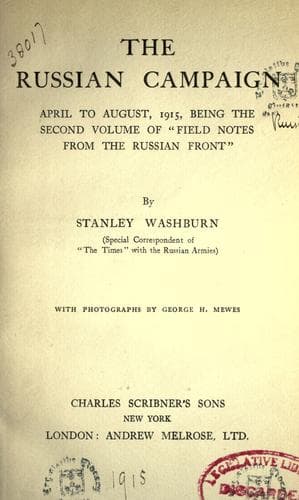
The Russian Campaign, April to August, 1915: Being the Second Volume of "Field Notes from the Russian Front"Washburn, Stanley
History
The Russian Campaign, April to August, 1915: Being the Second Volume of "Field Notes from the Russian Front"
Washburn, Stanley
World War, 1914-1918 -- Campaigns -- Eastern Front; World War, 1914-1918 -- Personal narratives
From this moment it was evident that Warsaw was doomed. To weaken the
Front on the Blonie line meant a break there, and re-inforcements
could not be sent either from the Narew line or the Southern Front
where actions still raged. It was then clearly a mate in a few moves,
if the Russians waited for it. But they did not. Instantly began
their military evacuation, the cleverness of which must I think
be credited to Alexieff and his brilliant Chief of Staff Goulevitch.
Those of us who have been studying the Warsaw situation for ten months,
imagined that when the evacuation came, if it ever did, it would be
through the city. What happened was entirely unexpected. The corps at
Gorakalwara slipped over the river on pontoon bridges in the night,
supporting the first corps that was already there, effecting the double
purpose of getting out of the Warsaw zone, and simultaneously coming
in between the Germans and the line of retreat toward Brest. About
the same time the corps that lay next to the Vistula, on the Northern
end of the Blonie line, slipped out over pontoon bridges and went to
support the Narew defenders, thus making impossible the immediate
breaking of that line. On August 4, by noon, there was probably not
over one corps on the West side of the Vistula. Half of that crossed
south of Warsaw before six, and probably the last division left about
midnight, and at three a.m. the bridges were blown up. The Germans
arrived at six in the morning, which seemed to indicate that they were
not even in touch with the Russian rearguard at the end.
What I have written above is to the best of my information the outline
of the Warsaw situation, but it may be in details somewhat inaccurate,
though I think the main points are correct. In any case there is no
question that the whole withdrawal was cleverly accomplished, and in
perfect order, and that when the Germans finally closed in, they found
an abandoned city. Their reports of having carried Warsaw by storm are
undoubtedly true to the extent that they were in contact with some
of the last troops to leave. Probably the trenches that they carried
by storm were held by a battalion or two of soldiers protecting the
rearguard. That the great body had gone long before the Germans know
perfectly well, and their claims of having carried the city by assault
would, I dare say, bring a smile even to the stolid face of the German
soldier.
Public-domain text, read in full here on John Shaqi.
Reviews
Reviews
No reviews yet
Be the first to share your thoughts on this work.
Elsewhere in the archive
Join the Discussion
Join the discussion
Sign in to leave a comment or review.
Sign InorCreate an account