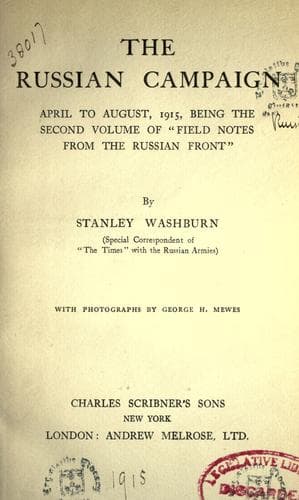
The Russian Campaign, April to August, 1915: Being the Second Volume of "Field Notes from the Russian Front"Washburn, Stanley
History
The Russian Campaign, April to August, 1915: Being the Second Volume of "Field Notes from the Russian Front"
Washburn, Stanley
World War, 1914-1918 -- Campaigns -- Eastern Front; World War, 1914-1918 -- Personal narratives
During all these operations the Germans had at least five shells to
the Russians, one, and but for this great superiority they never would
have pushed back either the line of the Narew or the Cholm-Lublin line.
Russia could not convert her resources into ammunition, and Germany,
who for forty years has lived for this day, could. To this fact she
owes her capture of Warsaw. The Allies may be assured that Russia
stayed until the last minute and the last shell, and then extricated
herself from an extremely dangerous position, leaving the enemy to
pounce on the empty husk of a city from which had been taken every
movable thing of military value. The defence of and final escape from
Warsaw is one of the most spectacular and courageous bits of warfare
that history presents, and undoubtedly the fair-minded German admits it
in his own heart regardless of the published statements of the Staff.
[Illustration: Siberians leaving the last trench before Warsaw.]
CONCLUSION
[Illustration: A batch of German prisoners captured during the retreat
from Warsaw.]
CHAPTER XXV
CONCLUSION
Dated:
PETROGRAD,
_September 2, 1915_.
A great deal has happened since the Fall of Warsaw which one must
regret, but at the same time the incidents or disasters must be viewed
in their proper perspective. The loss of Kovno, Novo-Georgievsk and
many other positions are all unfortunate, but must I think be taken
as by-products of the loss of Warsaw. With these enormous extended
fronts which modern war presents for the same time, there always
develop certain points on the line which may be called keystones. In
the Galician campaign, the Dunajec line and Gorlice was the keystone.
Once this was pulled out and a number of corps eliminated, the whole
vast line from the Vistula to the Bukovina was thrown into a state of
oscillation. Once the withdrawal of one army started, the whole line,
even to the Warsaw Front, was affected. Armies such as the Bukovina
army, which was actually advancing for ten days after the first attack
began hundreds of miles away, first halted and finally had to come
back to maintain the symmetry of the whole. A great Front, changing
over hundreds of versts, means that the whole line can stop only when
the weakest unit can stop. A chain is no stronger than its weakest link
and the same is roughly true of a Front.
Public-domain text, read in full here on John Shaqi.
Reviews
Reviews
No reviews yet
Be the first to share your thoughts on this work.
Elsewhere in the archive
Join the Discussion
Join the discussion
Sign in to leave a comment or review.
Sign InorCreate an account