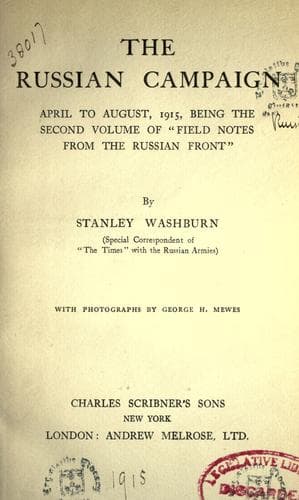
The Russian Campaign, April to August, 1915: Being the Second Volume of "Field Notes from the Russian Front"Washburn, Stanley
History
The Russian Campaign, April to August, 1915: Being the Second Volume of "Field Notes from the Russian Front"
Washburn, Stanley
World War, 1914-1918 -- Campaigns -- Eastern Front; World War, 1914-1918 -- Personal narratives
An Austrian sister who had been working in the hospital confirmed
the story. “Is it true that people were starving here?” I asked her.
“Indeed it is true,” she told me, “the soldiers had almost nothing and
the civilians were little better off. As for us in the hospitals--well,
we really suffered for want of food.” “But how about the officers?” I
asked. She looked at me sharply out of the corner of her eyes, for she
evidently did not care to criticize her own people, but she seemed to
recall something and her face suddenly hardened as she snapped out:
“The officers starve? Well, hardly. They lived like dukes always.” More
she would not say, but the evidence of these two was amply confirmed
by the sight of the sleek well-groomed specimens of the “dukes” that
promenade the streets. While the soldiers were in a desperate plight
for meat, the officers seemed to have retained their own thoroughbred
riding horses until the last day. I suppose that riding was a necessity
to them to keep in good health. The day before the surrender they gave
these up, and 2,000 beautiful horses were killed, not for meat for the
starving soldiers be it noted, but that they might not fall into the
hands of the Russians. Perhaps I can best illustrate what happened
by quoting the words of a Russian officer who was among the first
to enter the town. “Everywhere,” he told me, “one saw the bodies of
freshly-killed saddle horses, some of them animals that must have been
worth many thousand roubles. Around the bodies were groups of Hungarian
soldiers tearing at them with knives; with hands and faces dripping
with blood, they were gorging themselves on the raw meat. I have never
seen in all my experience of war a more horrible and pitiable spectacle
than these soldiers, half crazed with hunger, tearing the carcasses
like famished wolves.” My friend paused and a shadow crossed his
kindly face. “Yes,” he said, “it was horrible. Even my Cossack orderly
wept--and he--well, he has seen much of war and is not over delicate.”
Public-domain text, read in full here on John Shaqi.
Reviews
Reviews
No reviews yet
Be the first to share your thoughts on this work.
Join the Discussion
Join the discussion
Sign in to leave a comment or review.
Sign InorCreate an account