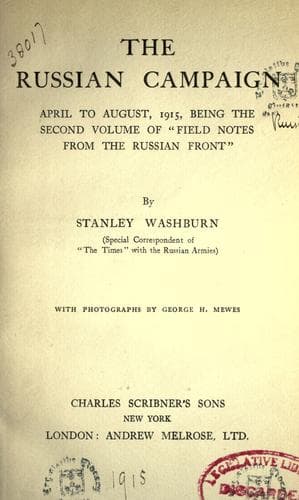
The Russian Campaign, April to August, 1915: Being the Second Volume of "Field Notes from the Russian Front"Washburn, Stanley
History
The Russian Campaign, April to August, 1915: Being the Second Volume of "Field Notes from the Russian Front"
Washburn, Stanley
World War, 1914-1918 -- Campaigns -- Eastern Front; World War, 1914-1918 -- Personal narratives
The night before the surrender, the Austrians began destroying their
military assets, and for two hours the town was shaken with the heavy
explosions of bridges and war material of all sorts. Every window
facing the San river was broken by the overcharge of the explosives
that destroyed the bridges. Simultaneously the work of destroying the
artillery was going on in all the forts with such efficiency, that it
is doubtful if the Russians will get a single piece that can be used
again. The soldiers even destroyed the butts of their muskets, and the
authorities, who were evidently keen on this part of the work, arranged
for tons of munitions to be dumped into the river. Others were assigned
to kill the saddle-horses.
By daylight the task seems to have been completed and negotiations for
surrender were opened by the Austrians. Our guide, Captain Stubatitch,
was the first Russian to enter the town as a negotiator, and through
him the meeting of ranking officers was arranged--a meeting that
resulted in the unconditional surrender of the fortress. The original
terms agreed on between Kusmanek and General Silivanov, the commander
of the Russian forces, did not permit the Austrian officers to carry
their side arms; but a telegram from the Grand Duke spared them the
humiliation of giving up their swords, a delicate courtesy, which it
seems to the writer was quite wasted on the supercilious Austrian
officers. In the first place there has been no formal entrance of
Russian troops, Silivanov himself not yet having inspected his
prize. The first Russians to enter came in six military touring cars
absolutely without any escort, and went quietly and unostentatiously to
the head-quarters of the Austrian commander where the affairs of the
town were transferred with as little friction as the changing of the
administration of one defeated political party into the hands of its
successor. Following the officials, small driblets of troops came in
to take over sentry and other military duties, and then came the long
lines of Russian transport bringing in supplies for the half-famished
garrison. All told, probably there have not been above a few thousand
Russian soldiers in Przemysl since its capitulation, and these were
greeted warmly by both prisoners and civilians. There has been no
friction whatever and everybody seems well satisfied with the end of
the siege. The greatest task at first was the relief of the population,
both soldiers and civilians. Countess Schouvalov, whom I have
mentioned before, came the second day and immediately began feeding the
population from the depôt where she organized a kitchen and service of
distribution which alone takes care of 3,000 people a day. The Army
authorities arranged for the care of the soldiers and much of the civil
population as well, and in three days the situation was well in hand
and practically all the suffering eliminated.
[Illustration: Feeding Austrian prisoners en route to Lwow.]
Public-domain text, read in full here on John Shaqi.
Reviews
Reviews
No reviews yet
Be the first to share your thoughts on this work.
Join the Discussion
Join the discussion
Sign in to leave a comment or review.
Sign InorCreate an account