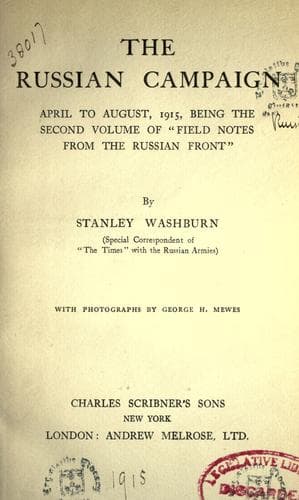
The Russian Campaign, April to August, 1915: Being the Second Volume of "Field Notes from the Russian Front" — John Shaqi
The Russian Campaign, April to August, 1915: Being the Second Volume of "Field Notes from the Russian Front"Washburn, Stanley
History
The Russian Campaign, April to August, 1915: Being the Second Volume of "Field Notes from the Russian Front"
Washburn, Stanley
World War, 1914-1918 -- Campaigns -- Eastern Front; World War, 1914-1918 -- Personal narratives
Warsaw, as I have seen it in nearly a dozen visits here since the
war began, is a little panicky in disposition, perhaps with reason;
and there have been such a continuous ebb and flow of rumours good
and bad, that for months no one knew what to expect. All through
December and January one heard every few days that the Germans would
take the town almost any time, only to be told the next day that all
chances of Teuton success were forever gone. Tales of German raids,
aeroplanes, Zeppelins on the way to destroy the city were circulated
so persistently, that perhaps it was not strange that genuine optimism
found the soil of local public opinion a difficult one in which to
take root. The end of the first week of February left the public here
greatly encouraged, for had not the stupendous German attack failed on
the Bzura-Rawka line?
But following close on its heels came the news of the movement in
East Prussia and Russian retirements, and once more confidence
fled. Later still the enemy’s advance on Przasnys and the threat to
the Petrograd-Warsaw line made conditions even worse. This was the
low-water mark. When the terrific attacks began to weaken and at last
the columns of the Kaiser began to give place, conviction that the
worst was over for Warsaw began to be felt generally, until to-day, May
1, I find a buoyancy and hopefulness here that I have not seen in any
part of Russia since the war started.
The reasoning of the people here is something like this. In the attacks
of January and February the Germans were putting into the field the
best men and the most of them that they could lay their hands on, and
still not weakening their position in the West. The onslaught on the
Bzura-Rawka line is believed to have been one of the fiercest efforts
that the Germans up to that date had made on any Front. Six corps and,
as it is said, 600 guns were concentrated on a short front and almost
without interruption they attacked for six days. The net result was
nothing save a few unimportant dents in the Russian line, and the
German loss is placed at 100,000 men. The Russians certainly did not
lose half that number, and some well-informed people who have been on
this Front for months think it may have been little more than a third.
Public-domain text, read in full here on John Shaqi.
Reviews
Reviews
No reviews yet
Be the first to share your thoughts on this work.
Join the Discussion
Join the discussion
Sign in to leave a comment or review.
Sign InorCreate an account