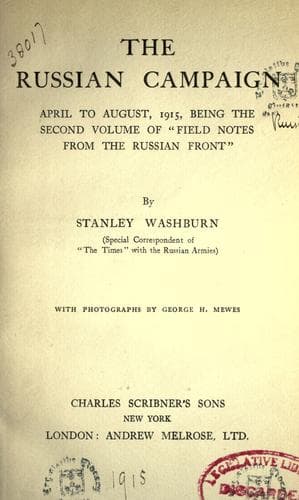
The Russian Campaign, April to August, 1915: Being the Second Volume of "Field Notes from the Russian Front"Washburn, Stanley
History
The Russian Campaign, April to August, 1915: Being the Second Volume of "Field Notes from the Russian Front"
Washburn, Stanley
World War, 1914-1918 -- Campaigns -- Eastern Front; World War, 1914-1918 -- Personal narratives
The work and experience with the Russian wounded have given this
American doctor a remarkable insight into the character of the
peasant soldier. “These moujik chaps,” he assured me, “never make a
complaint. I never saw anything like it. Sometimes they groan a little
when you’re digging for a bullet, but once off the table and in the
straw (we are without beds as we move too fast for that) a whole
barnful will be as quiet as though the place was empty; one German,
on the other hand, will holler his head off and keep the whole place
awake. The Russians never complain, and everything you do for them they
appreciate remarkably. I do a lot of doctoring for the villagers, and
every day there’s a line a block long waiting to get some ‘American’
dope, and they’re so grateful it makes you feel ashamed. Everybody
wants to kiss your hands. I tried putting my hands behind me, but those
that were behind were just as bad as those in front. Now I’ve given up
and just let them kiss.”
The vitality of the Russian soldier is amazing according to the
evidence of this observer. With the exception of wounds in the heart,
spine or big arteries there is nothing that must certainly prove fatal.
Many head wounds that seem incredibly dangerous recover. “I had one
case,” he told me, “which I never would have believed. The soldier
walked into my hospital with a bullet through his head. It had come
out just above his left ear and I had to dissect away part of the brain
that was lying on the ear, Well, that fellow talked all through the
dressing and walked out of the hospital. I sent him to the rear and I
have no doubt that he recovered absolutely.”
In the hundreds of cases operated on not a single death occurred on
the operating table and not one lung wound proved fatal. Many of the
abdominal wounds of the worst type make ultimate recoveries, and it
was the opinion of the surgeon that not above five to ten per cent. of
the patients who reached the first dressing stations died later from
the effects of their wounds. That the war was very popular among the
common soldiers was the conclusion that my friend had reached. “The
old men with families don’t care much for it,” he added, “but that is
because they are always worrying about their families at home, but the
young fellows are keen for it, anxious to get to the ‘Front’ when they
first come out, and eager to get back to it even after they have been
wounded. Some of them as a matter of fact go back several times after
being in the hospital.”
Public-domain text, read in full here on John Shaqi.
Reviews
Reviews
No reviews yet
Be the first to share your thoughts on this work.
Join the Discussion
Join the discussion
Sign in to leave a comment or review.
Sign InorCreate an account