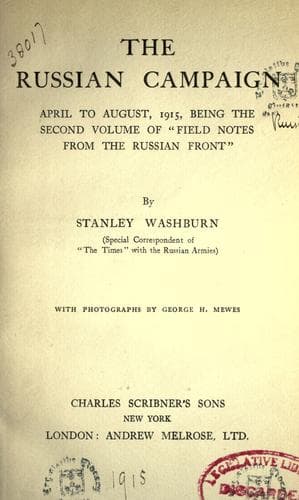
The Russian Campaign, April to August, 1915: Being the Second Volume of "Field Notes from the Russian Front"Washburn, Stanley
History
The Russian Campaign, April to August, 1915: Being the Second Volume of "Field Notes from the Russian Front"
Washburn, Stanley
World War, 1914-1918 -- Campaigns -- Eastern Front; World War, 1914-1918 -- Personal narratives
On every hand are evidences of increased Russian efficiency. The war
now has become strictly a matter of organization, and everything goes
on now without excitement and without confusion of any sort. Road
gangs have been organized, and these highways are maintained with as
much care as the permanent way of a railway line. One sign of the
times is the new departure of the Russian authorities, in building at
intervals of about every 5 versts a boiled water station, which is
distinguished by a special flag. Here in a shed closed on three sides
is a great boiler with numerous taps on it. When troops are passing in
any quantities the water is kept hot that the soldiers may always get
boiling water for their tea. When there is small movement on the road,
they can always get it cold for drinking purposes.
As it was Sunday we found the road practically free of transport.
Barring occasional soldiers sauntering along the highway there was no
sign of war until we were within a few miles of Radom, when, perhaps
20 versts to the west, columns of smoke, drifting lazily off in the
still air, indicated where some German battery had been shelling some
unfortunate village. Away off on the horizon a few faint puffs of white
in the blue showed where our batteries were breaking shrapnel under a
speck of an aeroplane, which had evidently been on a morning tour of
inspection. I was rather curious to see Radom, because for a week we
had been told in Warsaw that a terrible panic prevailed here, and that
the population were leaving in a frenzy of terror to avoid the sweep
of the Germans on Warsaw, that same old story which has for so many
months been circulated by the Jewish population. But Radom itself was
as quiet and casual as a city of the same size in far off America
might have been on a Sunday morning. The streets were crowded with the
population in their best clothes going to church, and the panic so
widely discussed in Warsaw was conspicuous by its absence.
I talked with a number of the townspeople, and they were as surprised
as they could be to know that they were all (according to Warsaw) in
full flight for the other side of the Vistula. What astonishes one most
is the absolute lack of information in one place of what is going on in
the next town. Kielce is but 30 miles from Radom, yet I could find no
one, neither officer nor civilian, who could say positively whether on
this particular day it was in our hands or in the hands of the enemy.
We did learn however from an officer that the road had been badly cut
up, and that fighting had taken place near Kielce, with destruction of
bridges, which would make it impossible for us to get there in a car.
As a fact, I learned later in the day that the road for perhaps 15
versts north of Kielce was held by German cavalry, and so was just as
well satisfied that we had not gone that way.
Public-domain text, read in full here on John Shaqi.
Reviews
Reviews
No reviews yet
Be the first to share your thoughts on this work.
Join the Discussion
Join the discussion
Sign in to leave a comment or review.
Sign InorCreate an account