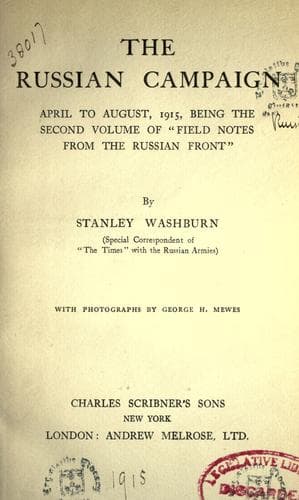
The Russian Campaign, April to August, 1915: Being the Second Volume of "Field Notes from the Russian Front" — John Shaqi
The Russian Campaign, April to August, 1915: Being the Second Volume of "Field Notes from the Russian Front"Washburn, Stanley
History
The Russian Campaign, April to August, 1915: Being the Second Volume of "Field Notes from the Russian Front"
Washburn, Stanley
World War, 1914-1918 -- Campaigns -- Eastern Front; World War, 1914-1918 -- Personal narratives
The ball was started, as far as I can learn, by a cavalry colonel who,
with a small command, attacked a pontoon bridge train that, in some
incredible way, was poking along in advance with only a meagre escort.
The advance of this small unit of horsemen served as a spark in the
Russian powder magazine, and within a few hours the whole corps was
engaged in an attack on the German infantry. It is hard to get any
accurate details of the operations, but this fighting lasted probably
two to three days. The ardent Russian regiments fell on the centre of
a German formation, which was said to be the 46th Landsturm corps,
smashed its centre and dissipated its flanking supports of a division
each. The Russians claim that 12,000 were left on the field and that
they took 6,000 prisoners. In any case there is no question that this
action put out at least one corps from further activity as an efficient
unit.
The German prisoners captured expressed themselves as greatly surprised
at the Russians attacking them. They had been told that the Russians
had all crossed the Vistula and were in rapid retreat to the west,
and that the probabilities were that the road to Moscow would be open
in a few weeks. From various members of the Russian Staff I obtained
many details as to the fighting in Galicia, which all agreed had been
terrific but was going extremely well for them on the line of the San
river. It is too soon to attempt a detailed account of this action,
but it will form one of the greatest stories of the whole war when the
returns are all in. Suffice it to say that the Russians had been aware
of the impending attack for several weeks, and had been preparing, in
case of necessity, a retirement on to a position upon the San river
with Przemysl as the salient thereof.
This Russian retreat did not come as a surprise even to the writer.
As far back as a month ago he was aware of feverish activities in
rehabilitating the Przemysl defences, and though at that time the
object was vague, it became clear enough when this crisis broke that
the Russians had foreseen the possibility of the failure to hold the
Dunajec line. The Germans carried this by a concentration of artillery
fire, probably greater even than that of the English guns at Neuve
Chapelle. So fierce was this torrent of flying steel that the Russian
line was eaten away in the centre, and in the Carpathian flank, and
there seems reason to believe that the army on the Dunajec was cut in
three sections when it began to retire. That it pulled itself together
and has been able to hold itself intact on the San up to the time of
this writing is evidence of the resiliency of the Russian organization.
Public-domain text, read in full here on John Shaqi.
Reviews
Reviews
No reviews yet
Be the first to share your thoughts on this work.
Join the Discussion
Join the discussion
Sign in to leave a comment or review.
Sign InorCreate an account