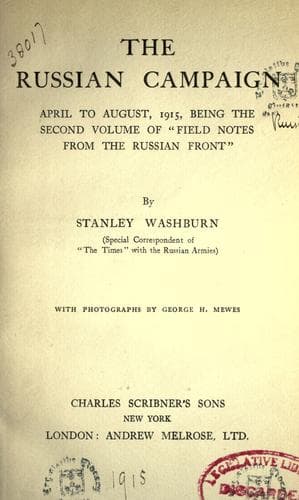
The Russian Campaign, April to August, 1915: Being the Second Volume of "Field Notes from the Russian Front" — John Shaqi
The Russian Campaign, April to August, 1915: Being the Second Volume of "Field Notes from the Russian Front"Washburn, Stanley
History
The Russian Campaign, April to August, 1915: Being the Second Volume of "Field Notes from the Russian Front"
Washburn, Stanley
World War, 1914-1918 -- Campaigns -- Eastern Front; World War, 1914-1918 -- Personal narratives
This was our place, and stopping the cars we climbed out to meet a
few officers sauntering down the road. They seemed to be coming from
nowhere in particular, but as I learned later, they lived in a kind of
cave dug out of the side of the road, and had been advised by telephone
that we were coming and so were on the lookout for us. The ranking
officer was a colonel of artillery--one of the kind that you would turn
about in the street to look at and to say to yourself, “Every inch a
soldier.” A serious, kindly-faced man in a dirty uniform with shoulder
straps so faded and frayed that a second look was necessary to get his
rank at all. For six months he had been living in just such quarters
as the cave in the side of the road where we found him. He was glad to
show us his observation. One could see at a glance that his whole heart
and soul were wrapped up in his three batteries, and he spoke of all
his positions and his observation points with as much pride as a mother
speaking about her children.
The country here is a great sweeping expanse, with just a few ridges
here and there like the one that we have come up behind. The country
reminds one of the valley of the Danube or perhaps the Red River Valley
in North Dakota, except that the latter has less timber in it. We are
ourselves quite uncertain as to where the enemy’s position is, for in
the sweep of the valley there is little to indicate the presence of
any army at all, or to suggest the possibility of hostilities from any
quarter. I asked one of the officers who strolled along with us where
the German lines were. “Oh, over there,” he remarked, casually waving
his hand in a northerly direction. “Probably they can see us then,”
I suggested. Personally I felt a mild curiosity in the subject which
apparently my companion did not share. He stopped and offered me a
cigarette, and as he lighted one himself, he murmured indifferently,
“Yes, I dare say they could see us if they turned their glasses on this
ridge. But probably they won’t. Can I give you a light?”
I thanked him politely and also commended the sun for shining in the
enemy’s eyes instead of over their shoulders as happened last night
when the observer in the German battery spotted us at 6,000 yards
and sent five shells to tell us that we were receiving his highest
consideration. On the top of a near-by hill was a small building which
had formerly been the Russian observation point, but the Germans
suspecting this had quickly reduced it to a pile of ruins. Near by
we entered a trench cut in from the back of the hill, and worked our
way up to an observation station cut out of the side of the slope in
front of the former position.
[Illustration: A first-line trench in Poland.]
Public-domain text, read in full here on John Shaqi.
Reviews
Reviews
No reviews yet
Be the first to share your thoughts on this work.
Join the Discussion
Join the discussion
Sign in to leave a comment or review.
Sign InorCreate an account