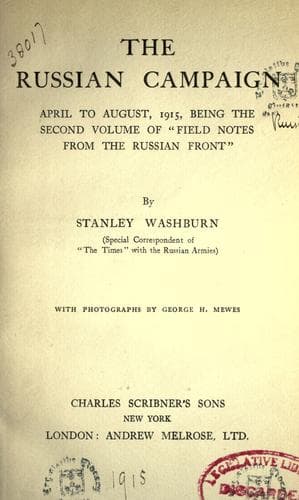
The Russian Campaign, April to August, 1915: Being the Second Volume of "Field Notes from the Russian Front" — John Shaqi
The Russian Campaign, April to August, 1915: Being the Second Volume of "Field Notes from the Russian Front"Washburn, Stanley
History
The Russian Campaign, April to August, 1915: Being the Second Volume of "Field Notes from the Russian Front"
Washburn, Stanley
World War, 1914-1918 -- Campaigns -- Eastern Front; World War, 1914-1918 -- Personal narratives
There are of course a large number of Austrians in Galicia, and ever
since the Russian occupation in September a pro-German-Austrian
propaganda has been kept up here. Every reverse to the Dual Alliance
has been minimized as much as possible, and every effort was subtly
made by the German-Austrian agents of the enemy to prevent the peasants
and that portion of the population here which sympathizes with the
Russians, from co-operating in the new régime. They were assured
that soon the Austrians would be coming back, and fears of reprisals
when the day came have no doubt restrained a large number of Little
Russians, Poles and others from openly supporting the efforts of
the new government to restore Galicia to its normal state. But with
each month it has become increasingly difficult for the Austrian
sympathizers to make the public believe that the Russian occupation was
only a temporary wave that would shortly recede. Austro-German advances
in Bukowina, and the really serious aggressive attempts through the
Carpathians no doubt helped to render conditions unsettled. Then
came the check of the Austrian advance in Bukowina and the gradual
reclaiming by the Russians of the ground lost at the first impetus
of the enemy’s offensive. This was followed by the failure of the
relieving column to make satisfactory headway toward its objective at
Przemysl.
In spite of all these very obvious failures to achieve any definite
advantage over the Russians, the spirits of the anti-Russian element
were kept buoyed up by the spectacle of the great fortress in Galicia
still holding out. “As long as Przemysl stands out there is hope,”
seems to have been the general opinion of all who wished ill to the
Russians. Thus the fortress, which at the outset might have been
abandoned with small loss of prestige to the Austrians, gradually
came to have a political as well as military significance of the most
far reaching importance. In the general crash after the battle of
the Grodek line, the loss of a town which until then had never been
heard of in the West, outside of military circles, would have escaped
anything more than passing comment. Not until the Russian armies had
actually swept past its trenches and masked its forts, did the world
at large know that such a place was on the map; even then the greatest
interest manifested was in the vexed question as to how its name was
pronounced, if indeed it could be done at all, an opinion which was
held by not a few people. This place which could have been given up
earlier in the war without any important sacrifice was held tenaciously
and became one of the vital points of strategy in the whole campaign.
An army which turned out to be a huge one, was isolated from the field
armies of Austria at a time when she needed every able-bodied man that
she could get; and Przemysl, which, as we see now, was doomed from the
start, was allowed to assume an importance in the campaign which made
Public-domain text, read in full here on John Shaqi.
Reviews
Reviews
No reviews yet
Be the first to share your thoughts on this work.
Join the Discussion
Join the discussion
Sign in to leave a comment or review.
Sign InorCreate an account