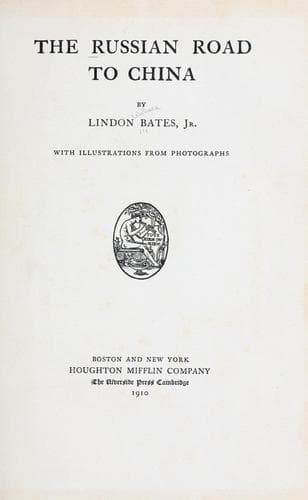
China -- Description and travel; Siberia (Russia) -- Description and travel; Velikaia Siberskaia magistral
On the box-top, beneath the gods, are set out in neat array the best
of Mongol dainties. These are disposed in little polished brazen
cups shaped like wine-glasses. There are raisins and dried plums,
caravan-carried from the far-off Middle Kingdom, and lumps of sugar
brought down from Russia in some trader’s pack. Millet fills one cup,
water another; each symbolizing some ancient seizin. A wick, sunk in
oil, flares in the centre, and casts a flickering, uncanny light upon
the deities. Spread on a low seat, six inches above the felt rug on
the floor, are rows after rows of _boba_, the gray Mongol biscuits, in
shape like the thick soles of a sandal. As a centre-piece between the
stacked loaves rests the brown roasted sheep’s head. It is the feast
of the New Year that this unusual volume of offerings betokens. The
old year of the Horse passes with the rise of to-night’s new moon. The
leap-year--that of the Ram--will then begin. All the families in the
_eimucks_ of Mongolia will feast on the grosser part of the offering
which now lies in its ranked regularity undisturbed. For the present
the priest takes light refreshments while waiting for his midnight rite.
“Will you have some of the tea that has been brewed for you by the old
mother while you were looking at the altar?” asks Alexsimevich.
It has been made, not from the loosely-packed leaves, but from the
hard tea-bricks. A chunk of this has been cast into the great iron bowl
over the brazier when the fagot-fed fire has melted the ice and has
brought the water to a boil.
Solemnly you are presented a wooden bowl of tea, which you receive in
both hands, and as solemnly sip. The evening meal is cooked and eaten,
your sugar reciprocating the lama’s tea.
As the evening wears on, amid the smoke of cigarettes and brass-bowled
pipes, the lama brings out quaint paper slips of Buddhist prayers.
“You are interested?” He will write for you a charm. “_O mani
padmihom_,” he tells you. “The Buddhist prayer.”
“Oh, thou jewel in the lotus-flower, hail!” says the interpreter.
It is mighty, this ancient Buddhist prayer, which is murmured by so
many millions from Japan to Persia, from Malay to Siberia. It is
symbolic, esoterically, of much. The jewel is the soul, the lotus is
Buddha, the prayer, a wish that the spirit be in them which was in
_Saka-muni_, their Lord. On endless rosaries this prayer is told. It is
on the lips of priests and women, it is carved around the stones which
travelers throw upon the _obos_, the “high-places” of Old-Testament
record. It is murmured by the pilgrims as they prostrate themselves.
The disciplined body, the praying tongue, and the mind intent on sacred
things, all incline the soul to the acquirement of merit.
Public-domain text, read in full here on John Shaqi.
Reviews
Reviews
No reviews yet
Be the first to share your thoughts on this work.
Elsewhere in the archive
Join the Discussion
Join the discussion
Sign in to leave a comment or review.
Sign InorCreate an account