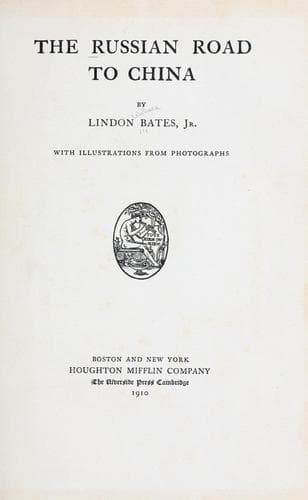
China -- Description and travel; Siberia (Russia) -- Description and travel; Velikaia Siberskaia magistral
For our race there is always felt, behind the soul-mask of Chinese
eyes, a contempt. The kindness of our host to-day is unfailing. Yet we
are not at ease or sure of the ground. Errors, condoned to keep face,
are often inwardly resented. If you put your hat on the Mongol’s altar,
everybody in the hut will yell out for you to take it off. When you
remove it, they will nod understandingly as the interpreter explains
that the ignorant foreigner transgressed inadvertently. Forthwith all
is forgotten in an enthusiastic discussion of the last case of botts
among the horses. But with these Chinese one can never tell if, by
taking a chop-stick between the wrong fingers, one has not intimated
that the host’s grandfather was a cross-eyed coolie soldier. No one
will challenge or set a man right, but the breach will be silently
resented, though the tea continues to be smilingly offered.
The old-time Chinese dealers at Urga grew enormously wealthy in the
tea-trade to Kiahta. These have mostly gone back to China. But there
are still a number of the better-class merchants whose wares are sold
to the traders and by them to the Mongols. The house of Liu-Shang-Yuan
claims two hundred years of establishment. The Urga people are still
prosperous, for great sums in religious tribute come from all Mongolia
to this Lourdes of Lamaism. There are also many Chinamen who make large
profits from wool.
Of a total trade in Urga estimated at twenty-five million roubles per
year, nine tenths is in the hands of Celestials. The remainder is
Russian, for the Mongols are entirely without a merchant class. Of the
exports, wool is the main item. Some two hundred thousand _puds_ are
sent from Urga annually, four fifths of which go to the United States.
While cotton cloth, cutlery, kitchen-utensils, and other European
goods come down from Russia, the bulk of the imports are brought from
China by caravan, through Kalgan. Silks come from Shanghai, and tea
from Hankow, passing via Peking. There is trade, too, with Ulasati in
western Mongolia. It is the centre of a fur and hide country which is
isolated from outlets toward Russia by the high mountains, and must
send caravans to Kiahta. Its communication with China is either by Urga
and Kalgan, or by the caravan-route further south.
When the holiday-time is over we see more of the Chinese traders.
Sitting in the shops, with one of these, and glancing out over the
little counter of the sales-room, we converse as the customers come and
go.
Public-domain text, read in full here on John Shaqi.
Reviews
Reviews
No reviews yet
Be the first to share your thoughts on this work.
Elsewhere in the archive
Join the Discussion
Join the discussion
Sign in to leave a comment or review.
Sign InorCreate an account