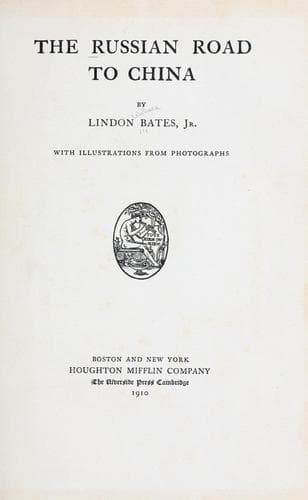
China -- Description and travel; Siberia (Russia) -- Description and travel; Velikaia Siberskaia magistral
Near-by the imposing magazine is a low one-story booth occupied by
a watchmaker. Beyond that is a walled enclosure with lofty gates,
as befits a school. Still further is the yellow and green sign of a
government liquor-_traktir_. The name is said to be derived from the
French word _traiteur_, which was current in the days when Napoleon
and Bourrienne were planning conquests in their Parisian poverty.
As we turn up a side street, the shops for the poorer people appear.
Gaudy pictures, of packages of tea, vegetables, and sugar-loaves,
illuminate the walls, to tell the unlettered that groceries are
sold within. Saws and hammers and vises are painted on the walls
of the hardware-shops. Loaves of bread, crescent rolls, and rococo
wedding-cakes decorate a bakery; boots and high-heeled slippers, a
shoemaker’s booth. The street is an open-air gallery of rude frescoes.
Presently we come to residences, some of cement-covered brick, with
high enclosing whitewashed walls and iron gates, some wooden, with
their rough-hewn logs unpainted save for the brilliant white sills and
window-frames.
At length, far from the town’s busy district, the Post-Office is
reached. The building is thronged. Two soldiers are loading their
saddle-bags with the mail for the regiment. Women are collecting
money-orders. A crowd waits at the window of the girl who sells stamps.
In rushing industry she makes the calculating beads of her abacus
fly across the wires. Everybody is far too occupied to register a
voyageur’s name,--excepting always the half-dozen soldiers posted in
different parts of the room and leaning stolidly upon their bayonets.
We venture to ask one of them which is the registry window.
“_Russisch verstehe ich nicht_,” is the answer.
A Siberian post-guard knowing no Russian and answering in German seems
extraordinary.
“Where are you from?” we inquire in his native tongue.
“Courland,” he answers,--“Courland by the Baltic.”
This city of Irkutsk gave trouble in 1905. If it gives trouble again,
the garrison will be safe.
The registering at length is done and we turn to go out. A tattered
figure, bearded and haggard, with rags bound on his feet, opens the
outer door.
“Will the _gaspadine_ help a man get back to Russia?”
Your companion looks closely at him.
“A convict! very bad people.” He adds: “There is a murder every day
here, and one cannot safely go out at night. Very bad men!”
With the contradictory charity that is so typical of the Russian, he
fumbles in his pocket and gives the unfortunate a fifty-kopeck piece.
Public-domain text, read in full here on John Shaqi.
Reviews
Reviews
No reviews yet
Be the first to share your thoughts on this work.
Join the Discussion
Join the discussion
Sign in to leave a comment or review.
Sign InorCreate an account