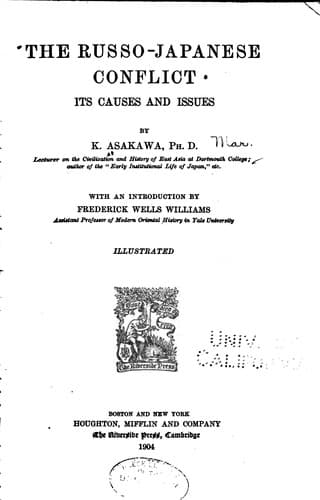
The Russo-Japanese Conflict: Its Causes and IssuesAsakawa, Kan'ichi
History
The Russo-Japanese Conflict: Its Causes and Issues
Asakawa, Kan'ichi
Russo-Japanese War, 1904-1905; Russo-Japanese War, 1904-1905 -- Causes
When we recall that even before 1900 Russia desired to control the
railway enterprises, not only in Manchuria, but also on the right side
of the Liao River, it is not altogether strange that, simultaneously
with the occupation of Manchuria, the northern Chinese line was seized
by her troops. This action, however, did not stop at the Great Wall. Had
it not been for the protest of Great Britain, the Russians would have
seized the entire line from Niu-chwang up to Peking. During the latter
part of June, they captured the Tientsin depot, burned the office,
destroyed the safe and the documents it contained, and seized land, some
tracts of which had been owned by British subjects.[300] On July 8, the
Northern Railway was seized and the British engineer, C. W. Kinder, and
his staff were turned out,[301] and, in spite of the dissent of the
British and American commanders, the Admirals of the allied Powers voted
on July 16 that the Russians should manage the railway.[302] In August,
the Russians claimed also the line between Tong-ku and Shanhai-Kwan, on
the one hand, and the one between Tientsin and Peking, on the other,
thus completing the control of the entire connection.[303] British
protests were in a measure waived by the new Commander-in-Chief of the
allied forces, Count von Waldersee, who early in October assigned the
repair of the section up to Yang-tsun to the Russians.[304] About this
time, fifty miles of railway material belonging to a British firm were
seized at Niu-chwang by the Russians,[305] followed by the seizure of
the collieries at Tong-shan and Lin-si hitherto operated by the Chinese
Engineering and Mining Company.[306] Other incidents followed, greatly
to the annoyance of those whose interests had been invested in the
works. It was at this juncture that, on October 16, 1900, an Agreement
was signed between the Governments of Great Britain and Germany,
upholding the principle of the open door in China (Article 1),
disclaiming territorial designs upon China on the part of the
contracting Powers (Article 2), and supplemented by the following
(Article 3), embodying the well-known principle of the balance of power
at China’s expense: “In case of another Power making use of the
complications in China in order to obtain under any form whatever such
territorial advantages, the two contracting parties reserve to
themselves the right to come to a preliminary understanding as to the
eventual steps to be taken for the protection of their own interests in
China.”[307] This is the notorious Anglo-German Agreement, the fate of
which has been an object of much ridicule among writers upon Chinese
affairs of recent years. The diplomacy which had resulted in the
conclusion of this Agreement has not been made known to the public, but
as to the circumstances which had caused the two Powers to negotiate, it
may safely be inferred that; so far as the British side was concerned,
the Russian conduct in North China was a potent factor.[308] As to the
Public-domain text, read in full here on John Shaqi.
Reviews
Reviews
No reviews yet
Be the first to share your thoughts on this work.
Elsewhere in the archive
Join the Discussion
Join the discussion
Sign in to leave a comment or review.
Sign InorCreate an account