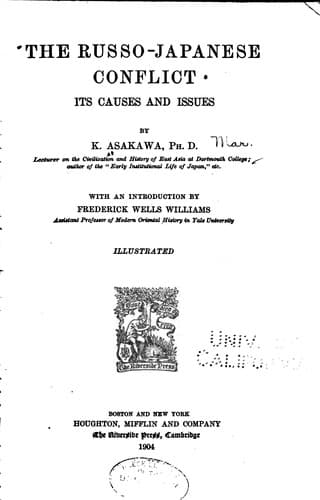
The Russo-Japanese Conflict: Its Causes and IssuesAsakawa, Kan'ichi
History
The Russo-Japanese Conflict: Its Causes and Issues
Asakawa, Kan'ichi
Russo-Japanese War, 1904-1905; Russo-Japanese War, 1904-1905 -- Causes
deeper causes on both sides for the extraordinary _rapprochement_, it is
easy to speculate upon but unsafe to asseverate them.[309] The Agreement
further stated that other interested Powers should be invited to accept
the principles recorded in it (Article 4). It is interesting to see how
this peculiar combination of the principles of (1) the open door, (2)
the integrity of China, and (3) a balance between the Powers on the
Chinese ground, was viewed by the other Powers. Japan joined the
Agreement on October 29, as a signatory, but not as an adhering
State.[310] France, Austria, and Italy recognized as identical with
their own all of the principles proposed,[311] while the United States
did likewise with the first two, but expressed itself unconcerned with
the third.[312] As for Russia, she seized this opportunity to indulge
her diplomatic sarcasm. She declared that, from her point of view, the
Agreement “did not perceptibly modify the situation in China,” and the
second principle perfectly corresponded with Russia’s intentions, as
“she was the first to lay down the maintenance of the integrity of the
Chinese Empire as a fundamental principle of her policy in China.” Her
reply to the first principle was delicately expressed, as follows: It
“can be favorably entertained by Russia, as this stipulation does not
infringe in any way the _status quo_ established in China _by existing
treaties_.”[313] In other words, the open door may or may not apply to
other places not yet covered by the existing treaties and still open to
whatever development might take place. The evil genius of the third
Article of the Anglo-German Agreement was not less skillfully answered
by Russia: “The Imperial Government, while referring to its Circular of
the 12th (25th) August, can only renew the declaration that such an
infringement [by another Power] would oblige Russia to modify her
attitude according to circumstances.”[314] From these words, it was
plain that outside of the two contracting Powers, the Agreement could
not exercise great influence, and least upon Russia, which declined to
observe any new feature in the instrument. The virtue of the Agreement
was, moreover, seriously impaired by the insincerity of one of its
parties, and by the consequent difference of views between themselves.
The document was openly talked about in Germany as the Yang-tsze
Agreement, it being meant that Great Britain thereby pledged herself to
abstain from annexing the Yang-tsze Provinces, hitherto considered, much
to the jealousy of Germany, as a British sphere of interest.[315] More
momentous was the question whether the Agreement included in its scope,
not only the eighteen Provinces, but also Manchuria. The answer would,
of course, depend upon whether both parties would consider, under the
provision of the third Article, that they alike possessed “their own
interests” to protect in Manchuria. Seen in this light, it is not
Public-domain text, read in full here on John Shaqi.
Reviews
Reviews
No reviews yet
Be the first to share your thoughts on this work.
Elsewhere in the archive
Join the Discussion
Join the discussion
Sign in to leave a comment or review.
Sign InorCreate an account