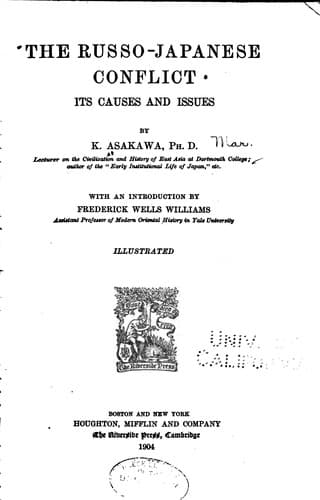
The Russo-Japanese Conflict: Its Causes and IssuesAsakawa, Kan'ichi
History
The Russo-Japanese Conflict: Its Causes and Issues
Asakawa, Kan'ichi
Russo-Japanese War, 1904-1905; Russo-Japanese War, 1904-1905 -- Causes
It was as early as January 12 that the Japanese Government had made
inquiries directly at the Russian Government regarding the contents of
the Agreement reported to have been made between Count Lamsdorff and
Yang-yu at St. Petersburg.[341] The report was apparently premature, for
its contents were unknown for more than a month after, and even on
February 18, Dr. Morrison reported from Peking that, according to a
telegram to the Chinese Government from Yang-yu, it would be several
days before Count Lamsdorff and M. Witte could settle the terms between
themselves of the new agreement they wished to propose.[342] The _Times_
correspondent, however, was able to send certain preliminary articles
which, he said, had been verbally communicated by M. Witte to
Yang-yu.[343] On February 27, Sir Ernest Satow[344] and Dr.
Morrison[345] simultaneously reported the contents of the agreement
which Yang-yu had been called upon by Count Lamsdorff to sign, and which
he had telegraphed to Peking on the 23d. The proposed convention was,
according to Dr. Morrison, obviously intended to exist side by side with
the Alexieff-Tsêng Agreement concluded in the previous November. The
substance of this convention, the authenticity of which the same writer
claimed to have been admitted by the Russians in Peking, was as
follows:—
1. “The Emperor of Russia, being desirous of manifesting his
friendship for China, ignores the outbreak of hostilities in
Manchuria, and agrees to restore the whole of that country to China,
to be administered in all respects as of old.
2. “By the 6th Article of the Manchurian Railway Agreement, the
Railway Company was authorized to guard the line with troops. The
country being at present in disorder, the number of those troops is
insufficient for the purpose, and a _corps_ must be retained until
order is restored and China has executed the last four Articles of
the present convention.
3. “In case of emergency the troops retained in Manchuria shall
render every possible assistance to China in preserving order.
4. “Chinese troops having been the greatest aggressors in the recent
attacks on Russia, China agrees not to organize an army until the
railway is completed and opened to traffic. When military forces are
organized eventually, their numbers shall be fixed in consultation
with Russia. The importation of arms and munitions of war into
Manchuria is prohibited.
5. “As a measure for the preservation of Manchuria, China shall
dismiss from office all Generals-in-Chief (Tartar Generals) and high
officials whose actions conflict with friendly relations, and who
are denounced for that reason by Russia. China may organize mounted
and foot police in the interior of Manchuria, but their numbers
shall be fixed in consultation with Russia.
“Cannon shall be excluded from their armament, and no subjects of
another Power shall be employed in the execution of the functions.
Public-domain text, read in full here on John Shaqi.
Reviews
Reviews
No reviews yet
Be the first to share your thoughts on this work.
Elsewhere in the archive
Join the Discussion
Join the discussion
Sign in to leave a comment or review.
Sign InorCreate an account