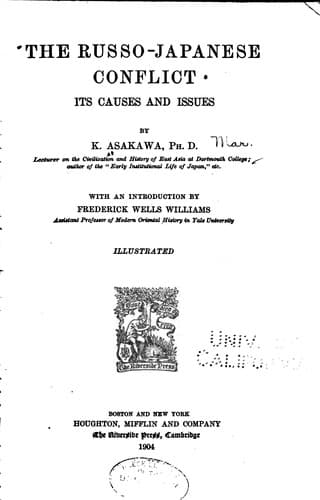
The Russo-Japanese Conflict: Its Causes and IssuesAsakawa, Kan'ichi
History
The Russo-Japanese Conflict: Its Causes and Issues
Asakawa, Kan'ichi
Russo-Japanese War, 1904-1905; Russo-Japanese War, 1904-1905 -- Causes
Russia allowed the question of the indemnity in Manchuria to be dealt
with at the general conferences at Peking together with the indemnity
respecting North China. In the matter of the punishment of guilty
local officials, from the discussion of which Russia abruptly withdrew
herself, the representatives of the other Powers included Manchuria in
their consideration.
Footnote 329:
_China, No. 2 (1904)_, No. 5 (January 4, 1901). Sir Charles Scott,
Ambassador at St. Petersburg, reported on January 5, that it appeared
to be generally believed there that “some provisional agreement, such
as that indicated, had been concluded by Russia with the local
authorities in Manchuria, and that she might eventually acquire by
treaty the right to finish building the railway line through Manchuria
to Port Arthur, and to protect it herself, the rights of the
Russo-Chinese Company being transferred to the Russian
Government.”—_Ibid._, No. 4.
Footnote 330:
The London _Times_, January 3, 1901, p. 3. In this and other reports
Dr. Morrison seems to have translated from Chinese texts.
Footnote 331:
The Russian _Official Messenger_ of April 6, 1901, stated that
“temporary agreements in writing (_modus vivendi_) respecting the
reëstablishment of the local civil administration in the _three
Provinces_ of Manchuria were, before all else, concluded between the
Russian military authorities and the Chinese tsian-tsiouns [Generals]
of the three Provinces.”—_China, No. 2 (1904)_, p. 22.
Footnote 332:
_China, No. 2 (1904)_, No. 5 (January 4).
Footnote 333:
The Tartar General Tsêng-chi was degraded for this offense, but Russia
succeeded in reinstating him.—_The Times_, February 20, 1901, p. 5.
Footnote 334:
_China, No. 2 (1904)_, No. 8.
Footnote 335:
_Ibid._, No. 13 (February 13).
Footnote 336:
The opinion of the German Government was that China “should not
conclude with any Power individual treaties of a territorial or
financial character _before_ they can estimate their obligations
toward all the Powers as a whole, and _before_ the compliance with
such obligations is accepted.”—_Ibid._, Nos. 12, 13.
Footnote 337:
_Ibid._, No. 19 (February 19).
What action the remaining Powers took is not shown in the Blue Books.
Austria-Hungary and Italy are said to have also protested.
Footnote 338:
_China, No. 2 (1901)._
Footnote 339:
_China, No. 2 (1901)._
Footnote 340:
_China, No. 2 (1904)_, No. 6.
CHAPTER X
A “STARTING-POINT”—THE LAMSDORFF-YANG-YU CONVENTION
Public-domain text, read in full here on John Shaqi.
Reviews
Reviews
No reviews yet
Be the first to share your thoughts on this work.
Elsewhere in the archive
Join the Discussion
Join the discussion
Sign in to leave a comment or review.
Sign InorCreate an account