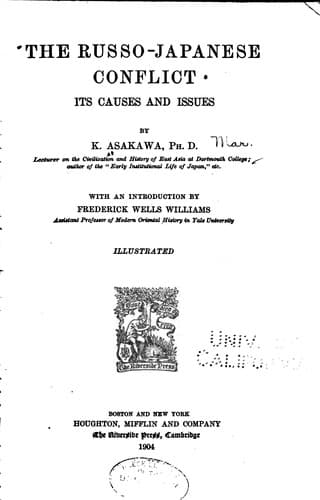
The Russo-Japanese Conflict: Its Causes and IssuesAsakawa, Kan'ichi
History
The Russo-Japanese Conflict: Its Causes and Issues
Asakawa, Kan'ichi
Russo-Japanese War, 1904-1905; Russo-Japanese War, 1904-1905 -- Causes
There never appeared an authentic text of the convention from either the
Russian or the Chinese official sources, but its existence in some
drastic form was intimated by the Viceroys Liu and Chang, and by the
Court Ministers then at Si-ngan, as well as by the Chinese Emperor
himself.[348] Furthermore, it could be plainly inferred that no one but
Chinese diplomatic officials could have let out the terms of the
proposed convention, or else it would have been impossible for one to
believe that an instrument of so immense a scope and so arbitrary a
nature, as had been reported, could have emanated from Russia. If the
reported text was in the main authentic, as Sir Ernest Satow believed it
was,[349] it is little wonder that Russia exercised a vigorous pressure
upon the Peking Government for a speedy signing of the convention before
the arrival of effective protests from other Powers, her Minister at
Peking stating to Prince Ching and Li Hung-chang that the Agreement
concerned only Russia and China, and that the Peking Government should
not take any notice of what the foreign Representatives might say about
it.[350] The Court appeared seized by a panic, excepting the pro-Russian
Li Hung-chang, who pretended that he considered that the proposed
convention would not impair the sovereignty of China in Manchuria.[351]
The Emperor, declaring that “it was impossible for China alone to incur
the displeasure of Russia by remaining firm,” appealed, on February 28,
to Great Britain, the United States, Germany, and Japan to mediate.[352]
The British Government at once instructed Sir Ernest Satow to stay the
hand of Li, who was about to sign, till he had received the replies of
the four Powers whose mediation had been formally requested by the
Emperor, and also to urge the patriotic Yang-tsze Viceroys to
memorialize the Throne against the acceptance of the Russian
proposition.[353] The Viceroys, as well as several other subjects of
China, had already done so.[354] The British remonstrance to China
against entering into separate agreements with individual Powers was
repeated on March 20.[355] At the same time Germany suggested, Great
Britain and Japan seconding, that China should refer the matter to the
conference of the foreign Representatives at Peking, who were, it should
be remembered, in the midst of their difficult discussion of the
preliminary terms of peace between the Powers and China.[356] It is
unnecessary to say that Japan, in concert with Great Britain, strongly
urged the Chinese Government not to sign the convention separately with
one of the Powers, for such an act was contrary to the principle of
solidarity which then united the Powers, and an individual convention
with a Power would materially lessen the capacity of China to meet her
obligations toward all the Powers.[357]
Public-domain text, read in full here on John Shaqi.
Reviews
Reviews
No reviews yet
Be the first to share your thoughts on this work.
Elsewhere in the archive
Join the Discussion
Join the discussion
Sign in to leave a comment or review.
Sign InorCreate an account