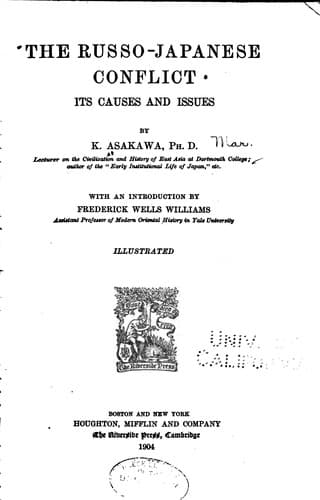
The Russo-Japanese Conflict: Its Causes and IssuesAsakawa, Kan'ichi
History
The Russo-Japanese Conflict: Its Causes and Issues
Asakawa, Kan'ichi
Russo-Japanese War, 1904-1905; Russo-Japanese War, 1904-1905 -- Causes
At this point we have to record a singular conjunction of circumstances
which has caused criticisms not altogether favorable to Russia. It has
already been shown that she had frequently had recourse to acts which at
once placed her somewhat apart from the community of the Powers, and
also were liable to be interpreted as being designed to ingratiate
herself with the afflicted China. Thus Count Lamsdorff more than once
deprecated the continuance of the punitive expeditions which the allied
forces made to one place or another in the Province of Chili.[358] His
reasons were so apparently plausible that, under different
circumstances, he might have been supported by certain other
Powers.[359] These very Powers, however, most keenly resented Russia’s
detachment from the allies, when she definitely cleared herself from the
deliberation of the Representatives of the Powers at Peking in regard to
the punishment to be inflicted by the Chinese Government upon certain
provincial officials who had been directly guilty of outrages to
foreigners during the recent trouble. The peace commissioners had almost
disposed of the punishment question, in order next to attack the knotty
problem of the indemnity to be paid by China, but M. de Giers had been
instructed by his Government “not only to abstain from entering into any
discussion as to the nature or method of execution of the capital
sentence, but also to take no part in the further discussions relative
to the punishment to be inflicted on the Chinese dignitaries.”[360] “At
the meeting [of the peace commissioners at Peking] to-day,” wrote Sir
Ernest Satow on February 28, the day after he reported the draft of the
most exhaustive agreement broached by Russia upon China, and the very
day when the Chinese Emperor appealed to Great Britain, Germany, the
United States, and Japan to intervene, “we presented to our colleagues
our list of provincial officials, of whom ten were named as deserving
the death penalty and about ninety to be punished in a lesser degree.
Objection was made only by the Russian Minister, who stated that he
could not accept our proposals unless he received fresh instructions,
and that his Government’s wish from the beginning had been to substitute
a less severe form of punishment for the death penalty. Both my French
colleague and I are of opinion that our death penalty list might justly
have included far more than what had been demanded, and is exceedingly
moderate in its reduced form.”[361] On March 15, that is, about the time
when the terms of her proposed agreement were, as will be presently
seen, modified by Russia in China’s favor, Sir Charles Scott wrote Lord
Salisbury that recently Count Lamsdorff had intimated that “he
considered the question of the punishment of Chinese officials at an end
as far as concerned Russia,” and that “he referred to the murders of the
missionaries as a subject in which Russia was not interested.”[362] Such
Public-domain text, read in full here on John Shaqi.
Reviews
Reviews
No reviews yet
Be the first to share your thoughts on this work.
Elsewhere in the archive
Join the Discussion
Join the discussion
Sign in to leave a comment or review.
Sign InorCreate an account