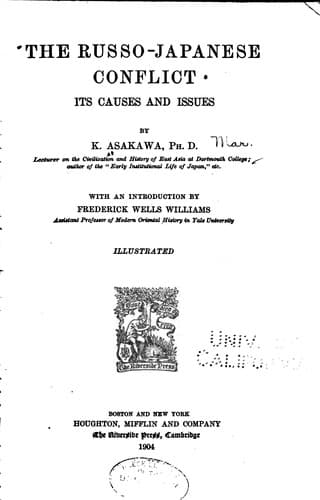
The Russo-Japanese Conflict: Its Causes and IssuesAsakawa, Kan'ichi
History
The Russo-Japanese Conflict: Its Causes and Issues
Asakawa, Kan'ichi
Russo-Japanese War, 1904-1905; Russo-Japanese War, 1904-1905 -- Causes
signature was desired by his Excellency in order that the unjust
suspicions aroused by false reports with regard to it might be removed
by its publication.”[376] Satisfied neither with this statement nor with
China’s refusal to sign the Agreement, the Japanese Government is said
to have made a second protest at St. Petersburg in a more resolute tone
than in the first, on April 5.[377] On the same day, however, appeared
in the Russian _Messager Officiel_ a long statement recapitulating
Russia’s relations with China since the beginning of the Boxer affair,
and declaring that, owing to the publication in the foreign press of all
sorts of false reports of the alleged treaties with China, and to the
serious obstacles that had apparently been put in the way of China as
regards the conclusion of an agreement with Russia serving as “a
starting-point” toward the restoration of Manchuria to China, “it had
been found impossible immediately to take the measures contemplated for
the gradual evacuation of Manchuria.” The negotiations had been dropped.
“With regard to the question of the complete and final restitution of
this territory to China,” concluded the official statement, “it is
evident that it can only be accomplished after a normal state of affairs
has been reëstablished in the Chinese Empire, and a central Government
has been secured in the capital, independent and sufficiently strong to
guarantee Russia against the renewal of the disturbances of last year.
While maintaining the present temporary form of government with the
object of insuring order in the neighborhood of the vast Russian
frontier, but remaining unalterably true to their original programme, as
repeatedly formulated, the Imperial Government will quietly await the
future progress of events.”[378]
-----
Footnote 341:
_China, No. 2 (1904)_, No. 6.
Footnote 342:
_The Times_, February 20, 1901, p. 5.
Footnote 343:
_Ibid._ “The Chinese argue,” added Dr. Morrison, “that Russia, having
no interests south of the Great Wall, no missionaries, no trade, and
no troops, can reasonably expect in return benevolent treatment from
China in any agreement proposed outside the Great Wall, especially as
Russia is in military occupation.... Russia appears determined to
profit by the condition to which China is reduced by the action of the
other Powers, just as she profited by obtaining the Primorsk Province
after the war of 1860, and Port Arthur and Talien-wan subsequent to
the war of 1895.”
Footnote 344:
_China, No. 2 (1904)_, No. 14. Cf. _ibid._, Nos. 25 and 42.
Footnote 345:
_The Times_, February 28, 1901, p. 5.
Footnote 346:
See pp. 91–92, above.
Footnote 347:
_China, No. 2 (1904)_, No. 42. Other versions are similar in substance
to this one, which was forwarded by Sir Ernest Satow.
Footnote 348:
See _China, No. 2 (1904)_, Nos. 16, 17, 32, 35.
Footnote 349:
_China, No. 2 (1904)_, No. 30.
Footnote 350:
_Ibid._, No. 18 (March 1).
Footnote 351:
Public-domain text, read in full here on John Shaqi.
Reviews
Reviews
No reviews yet
Be the first to share your thoughts on this work.
Elsewhere in the archive
Join the Discussion
Join the discussion
Sign in to leave a comment or review.
Sign InorCreate an account