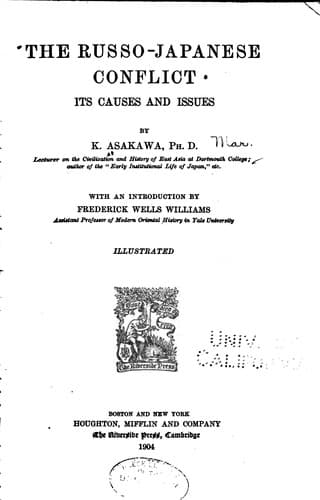
The Russo-Japanese Conflict: Its Causes and IssuesAsakawa, Kan'ichi
History
The Russo-Japanese Conflict: Its Causes and Issues
Asakawa, Kan'ichi
Russo-Japanese War, 1904-1905; Russo-Japanese War, 1904-1905 -- Causes
Let us now turn to see what explanations Russia had offered, for Japan
about January 12[372] and Great Britain on March 4[373] had made
inquiries at the Russian Government in respect to the actual text of the
Agreement. Lord Lansdowne repeated his query on March 9, adding that if
the version reported by Sir Ernest Satow was approximately accurate, it
was “impossible to describe it as a contract of a temporary and
provisional nature, and our treaty rights were certainly affected by
it.” Then, in his oft outspoken vein, the Marquess concluded: “On the
other hand, it is surely reasonable that we should ask his Excellency’s
[Count Lamsdorff’s] help in exposing the trick, and putting the saddle
on the right horse, if, as he suggests, garbled versions of the
Agreement are being circulated by the Chinese Government in order to
create dissension between the Powers; and you may state that to join the
Russian Government in exhibiting in its true light so discreditable a
manœuvre would afford the liveliest satisfaction to His Majesty’s
Government.”[374] Russia, however, would not communicate the text of the
proposed Agreement, and it was explained later by Count Lamsdorff that
there had been a “programme,” the detail of which had at one time or
another been under discussion, but there had never existed any regular
draft Agreement in twelve Articles; that the Czar had at no time given
him the full powers indispensable for concluding such an agreement, and
that in her negotiations with China [concerning the programme], three
different Departments of the Russian Government had been equally
engaged. These circumstances, and also “the unwise interference of the
press and public, which seemed to assert a very dangerous claim to be
admitted to a seat and voice in the councils of the Powers regarding
China,” made it very difficult for the Count to be as frankly
communicative as he would otherwise have wished to have been. Indeed,
“it would have been impossible for him to have discussed the details of
these negotiations with a third Government.”[375] To the Japanese
Minister, who had been instructed by his Government to make the friendly
proposal to Russia that the Representatives of the Powers at Peking
should be given an opportunity to consider the draft of the Manchurian
Agreement before it was signed, Count Lamsdorff replied in no less
interesting manner. He observed, on March 26, that the Agreement solely
concerned two independent States, and must be concluded without the
intervention of any other Powers, and politely but firmly declined to
consider any such proposal as was made by Japan. The Count added,
however, that “he could give an official assurance to the Japanese
Minister that neither the sovereignty and the integrity of China in
Manchuria nor the treaty rights of any other Power were affected by the
proposed Agreement; that it was of a provisional nature, and a necessary
preliminary to the Russian troops evacuating the province. Its early
Public-domain text, read in full here on John Shaqi.
Reviews
Reviews
No reviews yet
Be the first to share your thoughts on this work.
Elsewhere in the archive
Join the Discussion
Join the discussion
Sign in to leave a comment or review.
Sign InorCreate an account