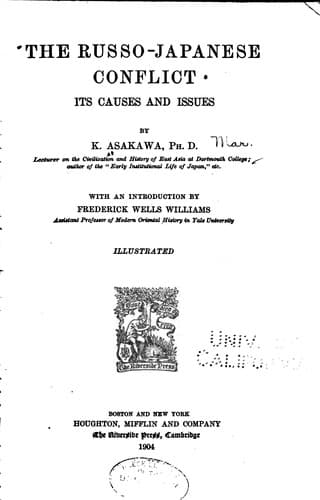
The Russo-Japanese Conflict: Its Causes and IssuesAsakawa, Kan'ichi
History
The Russo-Japanese Conflict: Its Causes and Issues
Asakawa, Kan'ichi
Russo-Japanese War, 1904-1905; Russo-Japanese War, 1904-1905 -- Causes
the proposed amendment.[385] Li soon passed away, on November 7,
leaving the gravest problem of China in a state of extreme
uncertainty. As to the contents of the Russian proposition, it is
interesting to observe that they were presently revealed from a source
whose veracity could hardly be questioned. On December 11, Prince
Ching disclosed them to Mr. Conger.[386] They coincided with those
that the latter had reported to Secretary Hay on the 3d, namely, that,
stated briefly, Russia should evacuate Manchuria, under the usual
conditions, in three years; that China should protect the railways and
Russian subjects in the territory; that she might station, in places
other than lands assigned to the Railway Company, mounted and foot
soldiers, whose numbers should, however, be determined by an agreement
with Russia, and who should exclude artillery; that troops of no other
nationality should be employed in protecting the railways; that the
Anglo-Russian Agreement of April, 1899, should be strictly adhered to;
that subjects of no other nationality should without Russian consent
be allowed to build railways or bridges in Southern Manchuria; and
that the Shan-hai-kwan-Niu-chwang-Sinminting Railways should be
returned to China after her payment to Russia of the expenditure
incurred by the latter in their occupation.[387] Prince Ching, it
appears, presented a counter-proposition to the Russian convention,
which, among other things, seems to have requested that the evacuation
of Manchuria should be completed within one year, instead of three, as
was provided in the original draft. Russia’s reply to this arrived in
Peking the last of January, 1902, agreeing to reduce the period of
evacuation from three to two years.[388] At the same time, however,
the Russian Government now strongly supported, in addition to the
proposed convention, a separate agreement proposed by the
Russo-Chinese Bank. The latter, according to Prince Ching, contained,
besides the railway concessions already granted to the Bank, provision
that China should herself undertake all industrial development in
Manchuria, but if she required financial help from the outside,
application should always first be made to the Russo-Chinese Bank;
only when the latter did not wish to engage in the work might citizens
of other countries be allowed to undertake it. A clause was also to be
inserted, the practical value of which is not clear, that citizens of
every country should have the same rights as they then did to trade at
the open ports and in the interior.[389] Prince Ching was obliged to
acknowledge to Mr. Conger, on January 19, 1902, that, owing to the
pressure which Russia increased simultaneously with the apparent
concessions she had made, she would yield no further, and “he was
convinced that, if China held out longer, they would never again
secure terms so lenient; that the Russians were in full possession of
the territory, and their treatment of the Chinese was so aggravating
Public-domain text, read in full here on John Shaqi.
Reviews
Reviews
No reviews yet
Be the first to share your thoughts on this work.
Elsewhere in the archive
Join the Discussion
Join the discussion
Sign in to leave a comment or review.
Sign InorCreate an account