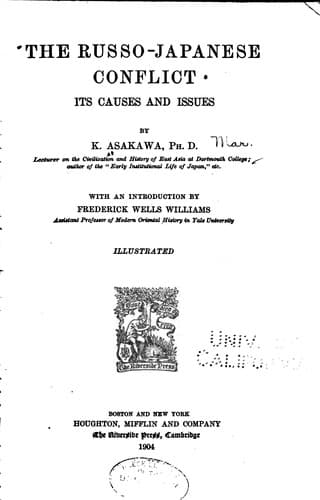
The Russo-Japanese Conflict: Its Causes and IssuesAsakawa, Kan'ichi
History
The Russo-Japanese Conflict: Its Causes and Issues
Asakawa, Kan'ichi
Russo-Japanese War, 1904-1905; Russo-Japanese War, 1904-1905 -- Causes
that longer occupation was intolerable; that they must be got out, and
that the only way left for China to accomplish this was to make the
best possible terms. The only terms that Russia would consent to were
the signing of both the Convention and the Russo-Chinese Bank
Agreement.”[390]
[Illustration:
LI HUNG-CHANG
]
It is unnecessary to say that against the Russian demands Great Britain,
Japan, and the United States had separately and more than once entered
firm protests at Peking. The conduct of the first two Powers, however,
is not shown in the published documents. Secretary Hay reminded the
Russian and Chinese Governments, on February 3, of the repeated
assurances made by the Czar’s Foreign Minister of his devotion to the
principle of the open door in all parts of China, and said: “An
agreement whereby China gives any corporation or company the exclusive
right or privilege of opening mines, establishing railroads, or in any
other way industrially developing Manchuria, can but be viewed with the
greatest concern by the Government of the United States. It constitutes
a monopoly, which is a distinct breach of the stipulations of the
treaties concluded between China and foreign Powers, and thereby
seriously affects the rights of American citizens.”[391] To this note,
the interesting reply of Count Lamsdorff, signed by himself, was: “...
It [the Russian Government] feels itself bound ... to declare that
negotiations carried on between two entirely independent States are not
subject to be submitted to the approval of other Powers. There is no
thought of attacking the principle of the ‘open door’ _as that principle
is understood by the Imperial Government of Russia_,[392] and Russia has
no intention whatever to change _the policy followed by her in that
respect up to the present time_. If the Russo-Chinese Bank should obtain
concessions in China, the agreements of a private character relating to
them would not differ from those heretofore concluded by so many other
foreign corporations.[393] But would it not be very strange if the
‘door’ that is ‘open’ to certain nations should be closed to Russia,
whose frontier adjoins that of Manchuria, and who has been forced by
recent events to send her troops into that province to reëstablish order
in the plain and common interest of all nations?... It is impossible to
deny to an independent State the right to grant to others such
concessions as it is free to dispose of, and I have every reason to
believe that the demands of the Russo-Chinese Bank do not in the least
exceed those that have been so often formulated by other foreign
companies, and I feel that under the circumstances it would not be easy
for the Imperial Government to deny to the Russian companies that
support which is given by other Governments to companies and syndicates
of their own nationalities. At all events, I beg your Excellency to
believe that there is not, nor can there be, any question of the
Public-domain text, read in full here on John Shaqi.
Reviews
Reviews
No reviews yet
Be the first to share your thoughts on this work.
Elsewhere in the archive
Join the Discussion
Join the discussion
Sign in to leave a comment or review.
Sign InorCreate an account