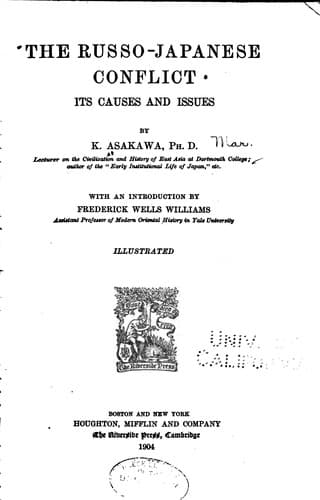
The Russo-Japanese Conflict: Its Causes and IssuesAsakawa, Kan'ichi
History
The Russo-Japanese Conflict: Its Causes and Issues
Asakawa, Kan'ichi
Russo-Japanese War, 1904-1905; Russo-Japanese War, 1904-1905 -- Causes
The St. Petersburg _Messager Officiel_ of March 20, published, with the
Declaration, the statement that the Russian Government had received the
announcement of the Anglo-Japanese Agreement “with the most perfect
calm,” for Russia likewise insisted on the maintenance and integrity of
China and Korea. “Russia,” it continued to say, “desires the
preservation of the _status quo_ and general peace in the Far East, by
the construction of the great Siberian Railroad, together with its
branch line through Manchuria, toward a port always ice-free. Russia
aids in the extension in these regions of the commerce and industry of
the whole world. Would it be to her interest to put forward obstacles at
the present time? The intention expressed by Great Britain and Japan to
attain those same objects, which have invariably been pursued by the
Russian Government, can meet with nothing but sympathy in Russia, in
spite of the comments in certain political spheres and in some of the
foreign newspapers, which endeavored to present in quite a different
light the impassive attitude of the Imperial Government toward a
diplomatic act which, in its eye, does not change in any way the general
situation of the political horizon.”[407]
It seems to be generally overlooked that, so far as the published
documents are concerned, there occurs no statement that the Russo-French
alliance extended from Europe to the Far East under precisely the same
conditions as those of the Anglo-Japanese Agreement. In other words,
although the general principles of the latter are indorsed, one finds
nowhere that its terms of war and neutrality and its provisions
regarding the duration of the validity of the instrument have also been
reproduced by Russia and France in their mutual convention. Regarding
the precise conditions of their alliance, therefore, the world is left
much in the dark, save what it takes for granted. Nor are the principles
of the integrity and the open door of China and Korea so fully and
explicitly stated here as in the Agreement of the rival allies, while
the reservation at the end of the Declaration does not make it clear
that these principles may not be discarded, under certain circumstances,
according to the interpretations of the parties themselves of the means
to be taken to safeguard their interests.
Public-domain text, read in full here on John Shaqi.
Reviews
Reviews
No reviews yet
Be the first to share your thoughts on this work.
Elsewhere in the archive
Join the Discussion
Join the discussion
Sign in to leave a comment or review.
Sign InorCreate an account