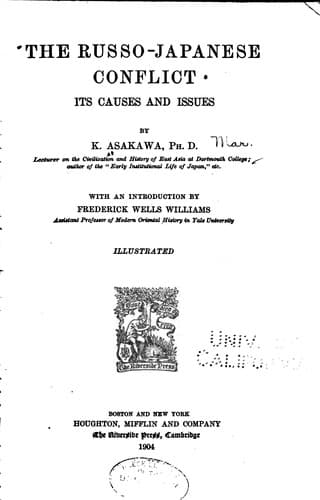
The Russo-Japanese Conflict: Its Causes and IssuesAsakawa, Kan'ichi
History
The Russo-Japanese Conflict: Its Causes and Issues
Asakawa, Kan'ichi
Russo-Japanese War, 1904-1905; Russo-Japanese War, 1904-1905 -- Causes
exclusive tendencies in China and Korea, and, what is equally important,
that the observation of these principles would forcibly tend to preserve
the general peace in the Far East. Owing to the covert violation of
these principles by another Power, however, peace has been broken, but
the Anglo-Japanese Agreement has not expired. The latter would, however,
fall to the ground the moment one of the parties, either as a result of
a war or otherwise, should attempt to depart from the principles of the
open door and the territorial integrity of the neighboring Empires.
Lord Lansdowne considered the Agreement “a measure of precaution,” and
hoped that it would “make for the preservation of peace, and that,
should peace be unfortunately broken, it would have the effect of
restricting the area of hostilities.” Presently these hopes were openly
seconded, but in reality neutralized, by the Russo-French Declaration of
March 17, which stated:—
“The allied Governments of Russia and France have received a copy of
the Anglo-Japanese Agreement of the 30th January, 1902, concluded
with the object of maintaining the _status quo_ and the general
peace in the Far East, and preserving the independence of China and
Korea, which are to remain open to the commerce and industry of all
nations, and have been fully satisfied to find therein affirmed the
fundamental principles which they have themselves, on several
occasions, declared to form the basis of their policy, and still
remain so.
“The two Governments consider that the observance of these
principles is at the same time a guarantee of their special
interests in the Far East.[405] Nevertheless, being obliged
themselves also to take into consideration the case in which either
the aggressive action of third Powers, or the recurrence of
disturbances in China, jeopardizing the integrity and free
development of that Power, might become a menace to their own
interests, the two allied Governments reserve to themselves the
right to consult in that contingency as to the means to be adopted
for securing those interests.”[406]
Public-domain text, read in full here on John Shaqi.
Reviews
Reviews
No reviews yet
Be the first to share your thoughts on this work.
Elsewhere in the archive
Join the Discussion
Join the discussion
Sign in to leave a comment or review.
Sign InorCreate an account