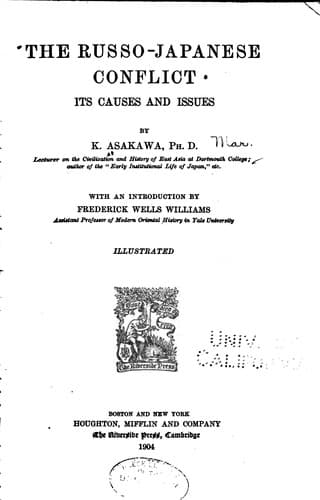
The Russo-Japanese Conflict: Its Causes and IssuesAsakawa, Kan'ichi
History
The Russo-Japanese Conflict: Its Causes and Issues
Asakawa, Kan'ichi
Russo-Japanese War, 1904-1905; Russo-Japanese War, 1904-1905 -- Causes
The position which one of the elder statesmen out of office, Marquis
Itō, occupied in this diplomatic evolution, has been a subject of much
speculation. He was not only on his tour in America and Europe when
the Agreement was concluded, but also had made efforts at St.
Petersburg to come to an _entente_ with Russia. From this, it has even
been charged that he was opposed to an Agreement with Great Britain.
It now appears, however, that he had discussed the latter question
with Premier Katsura before he sailed for Europe, and that he
proceeded to St. Petersburg with a full authorization from the
Government to exchange views with Count Lamsdorff regarding Korea. In
the mean time, the Cabinet continued its negotiations with Great
Britain. Each must have kept the other well informed of the progress
of the respective negotiations, with this important difference,
however, that Marquis Itō apparently entertained the view, which the
Cabinet respected without accepting, that a British alliance would be,
not less desirable, but more difficult of realization, than a Russian
agreement concerning Korea. Unexpectedly to the Marquis, his effort
did not materialize as well as he had hoped, while, on the other hand,
it seemed as if his significant presence in Russia had hastened the
hands of the jealous British Foreign Office, which now put its seal
upon the terms as agreed upon with rather unexpected readiness.
Footnote 402:
The writer is indebted to the _Kokumin Shimbun_ for many important
suggestions regarding the negotiations between the two Powers which
resulted in the conclusion of the Agreement. _Tokushu Jōyaku_, pp.
407–411, gives a brief explanatory view of the conditions under which
the Agreement was concluded.
Footnote 403:
_The British Parliamentary Papers, Treaty Series, No. 3, 1902:
Agreement between the United Kingdom and Japan relative to China and
Korea, signed at London, January 30, 1902._
Footnote 404:
The _British Parliamentary Papers: Japan, No. 1 (1902), Dispatch to
His Majesty’s Minister at Tokio, forwarding Agreement between Great
Britain and Japan, of January 30, 1902_.
Footnote 405:
Observe the clearness of this statement. This idea is only implied in
the Anglo-Japanese Agreement. It is remarkable that an explicit
statement of this nature should come, as it did, from the Powers from
which it would have been less expected than from their rivals.
Footnote 406:
_China, No. 2 (1904)_, No. 50. The so-called triple alliance of Europe
was renewed in May, with a declaration that it, together with the
Russo-French alliance, maintained peace. The latter, as is shown here,
had extended itself from Europe to the Far East, owing largely to the
conclusion of the Anglo-Japanese Agreement. The growing solidarity of
the world’s international politics may in some degree be discerned
here.
Footnote 407:
Public-domain text, read in full here on John Shaqi.
Reviews
Reviews
No reviews yet
Be the first to share your thoughts on this work.
Elsewhere in the archive
Join the Discussion
Join the discussion
Sign in to leave a comment or review.
Sign InorCreate an account